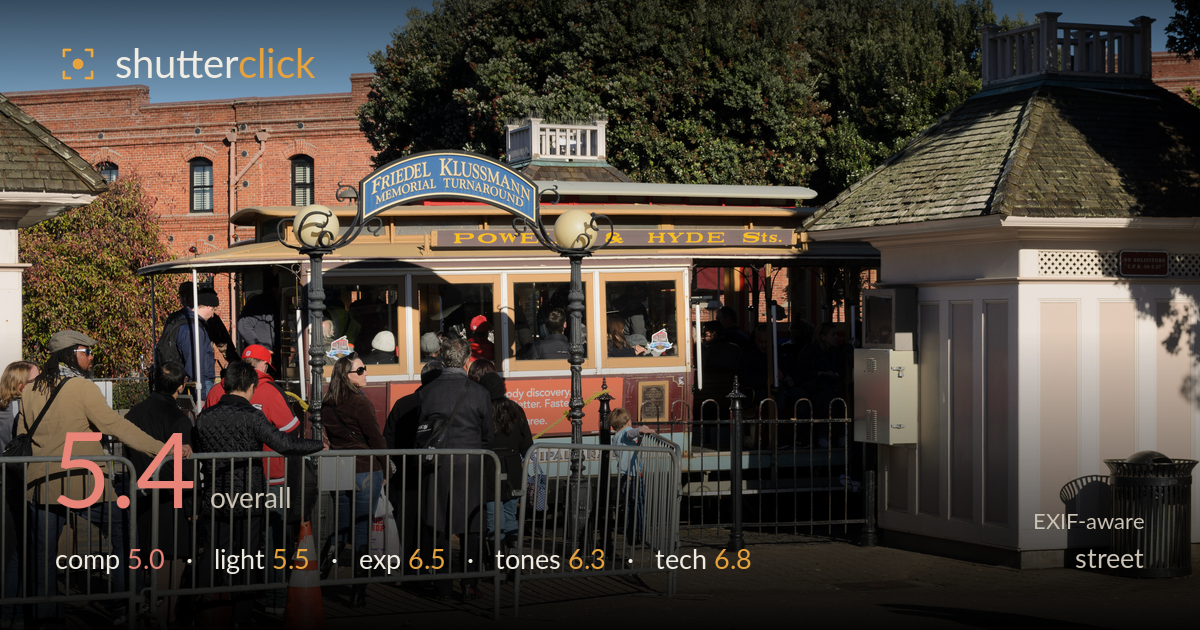
Waiting at the cable car turnaround
Photo by King of Hearts

| Focal length | 44 mm |
| Aperture | f / 8.0 |
| Shutter | 1/320 s |
| ISO | ISO 100 |
| Exp. comp. | 0.0 EV |
| Shot at | 14:44 · Jan 13, 2013 |
This reads as a documentary record of the Powell & Hyde cable car turnaround rather than a street photograph with a decisive moment. The scene is information-rich — the ornate sign, the crowd, the queue barriers — but the eye has nowhere to settle. No single gesture or interaction carries the frame, and the foreground is cluttered with metal railings and a traffic cone that fight for attention. The technical execution is clean and the light is honest. What most holds it back is the lack of a subject and a clear reason for the composition to be framed exactly this way. A tighter moment would elevate the material.
The frame tries to hold everything at once — the cable car, the sign, the full queue, the ticket booth, and a wide expanse of empty paving — and as a result nothing leads the eye. The lamp posts and railings slice the crowd into fragments, and the traffic cone anchors the bottom awkwardly. The large foreground of brick paving is dead space that dilutes the energy. A stronger frame would isolate a single figure or interaction within the crowd, or use the sign as a deliberate anchor rather than one competing element among many.
Hard, high midday sun rakes across the scene from the left, throwing strong shadows across the paving and creating harsh contrast on faces. It renders the brick and the cable car's warm tones with good punch, and the sky is a clean deep blue. But this is the least flattering light for a crowd of people — squinting eyes, blown foreheads, deep eye-socket shadows. Softer light, or the raking warmth of late afternoon, would model the scene with more depth and reduce the contrast that flattens the faces here.
Exposure is well judged for the conditions. The deep blue sky retains full detail without clipping, and the highlights on the sunlit paving and the beige booth are held short of blowing out. Shadow areas inside the cable car and beneath the canopy go dark but retain enough structure to read. The overall balance is deliberate and even across a scene with a wide brightness range. Nothing is fighting the sensor here — the histogram is used sensibly across the frame, with only the deepest interior shadows losing detail.
Colour is natural and pleasing — the warm brick, the ochre cable car, and the red banner sit well against the cool blue sky, giving the frame a solid warm-cool balance. White balance is accurate under direct sun. Contrast runs a little high due to the harsh light, which deepens shadows more than ideal for a crowd scene. Saturation is restrained and believable rather than pushed. The tonal range is broad and handled honestly, though the midtones on the shadowed figures could use a lift to bring the people forward.
The settings are a textbook choice for this documentary-style scene. f/8 at 44mm delivers deep front-to-back sharpness, keeping the queue, the cable car, and the booth all in acceptable focus — appropriate when the whole scene is the subject. ISO 100 keeps the file clean with no visible noise, and 1/320s comfortably freezes the mostly static crowd and any slow movement. The 18-55 kit lens performs adequately here, with good detail in the sign lettering and brickwork; corners hold up fine at this aperture. Focus appears accurately placed on the mid-ground figures and the cable car. The one limitation is that these safe, everything-sharp choices reinforce the record-shot feel — there's no selective focus or depth control to guide attention to a subject. For a street frame with a chosen subject, a wider aperture to soften the busy background, or a longer focal length to compress and isolate a figure, would have served the intent better. Execution is sound; the creative decisions are conservative.
What would elevate it
Tags
Shot something like this?
Expert photo critique, on demand — scored across six categories, EXIF-aware. Start with 3 free critiques, no credit card.
critique my photo — free