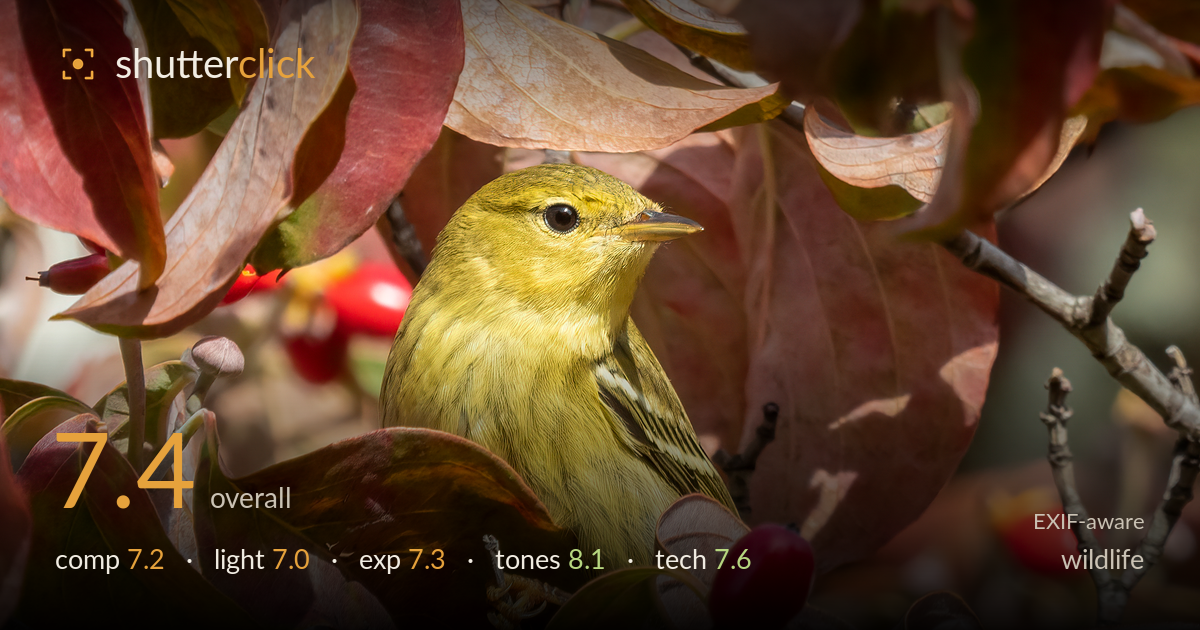
Warbler among autumn dogwood
Photo by Rhododendrites

| Focal length | 300 mm |
| Aperture | f / 9.0 |
| Shutter | 1/500 s |
| ISO | ISO 640 |
| Exp. comp. | 0.0 EV |
| Shot at | 13:17 · Oct 2, 2021 |
A warbler nested in autumn dogwood, and the colour relationship between the yellow bird, russet leaves, and scarlet berries is the photograph's strongest asset. The eye is sharp with a clean catchlight, and the head-and-shoulder pose reads well. What holds it back is clutter: leaves and twigs cross the frame and the bird sits low and slightly buried, competing for attention with foreground foliage. The right side is busy with bare branches that draw the eye off the subject. A cleaner angle or a moment where the bird cleared more of the surrounding leaves would let it breathe.
The bird is placed left of centre with its gaze into open frame, which works, and the red berries add welcome colour anchors. But the environment crowds the subject — leaves overlap the body and a spray of bare twigs on the right pulls attention away. The low placement leaves heavy foreground foliage below that adds little. A framing that isolated more of the head and upper body, or waited for the bird to perch clear of the crossing leaves, would strengthen subject separation considerably.
Hard, direct sunlight rakes across the scene, lighting the bird's face and breast cleanly and producing a strong catchlight in the eye. The same light, however, creates harsh specular highlights on the glossy leaves and blows small hotspots in the surrounding foliage. The dappled quality scatters bright and dark patches through the frame, competing with the subject. Softer light, or a position that put the bird in more even illumination, would render the plumage with less contrast and calm the background.
Exposure is well judged for the subject — the yellow plumage holds detail without clipping and the eye retains shadow information. The brighter leaf highlights nudge toward the top of the histogram but stay mostly recoverable. Midtones sit comfortably and the bird is neither muddy nor washed out. The main exposure concern is the scattering of bright specular spots on the leaves, which is a lighting-driven issue more than a metering fault. Overall a clean, deliberate reading for the conditions.
The colour palette is the photograph's highlight — warm russet and burgundy leaves surrounding the lemon-yellow bird, punctuated by saturated red berries, form a cohesive autumn harmony. White balance leans warm and suits the season. Saturation is rich without tipping into garish, and the tonal range runs from the dark eye to the pale leaf undersides with good gradation. The reds are strong but controlled. A touch less global contrast might soften the harsher leaf highlights, but the grading is confident.
The 40-150mm f/2.8 with the MC-20 at 300mm (600mm equivalent) is a capable wildlife setup, and the settings are largely sound. Focus lands accurately on the eye, which is sharp with visible detail in the plumage and the feet gripping the twig. At f/9 the depth of field is generous, keeping the whole bird sharp — reasonable given the head-on angle, though it also renders more of the busy background in focus, which adds clutter. A wider aperture around f/5.6 would have thrown the leaves further out and isolated the subject better while still covering the bird. 1/500s froze the stationary bird cleanly; for an active warbler a faster speed would offer more insurance. ISO 640 is modest and noise is well controlled with the teleconverter penalty accounted for. Sharpness is good across the subject, and the teleconverter has not visibly degraded resolution. Solid execution; the aperture choice is the main lever worth reconsidering.
What would elevate it
Tags
Shot something like this?
Expert photo critique, on demand — scored across six categories, EXIF-aware. Start with 3 free critiques, no credit card.
critique my photo — free