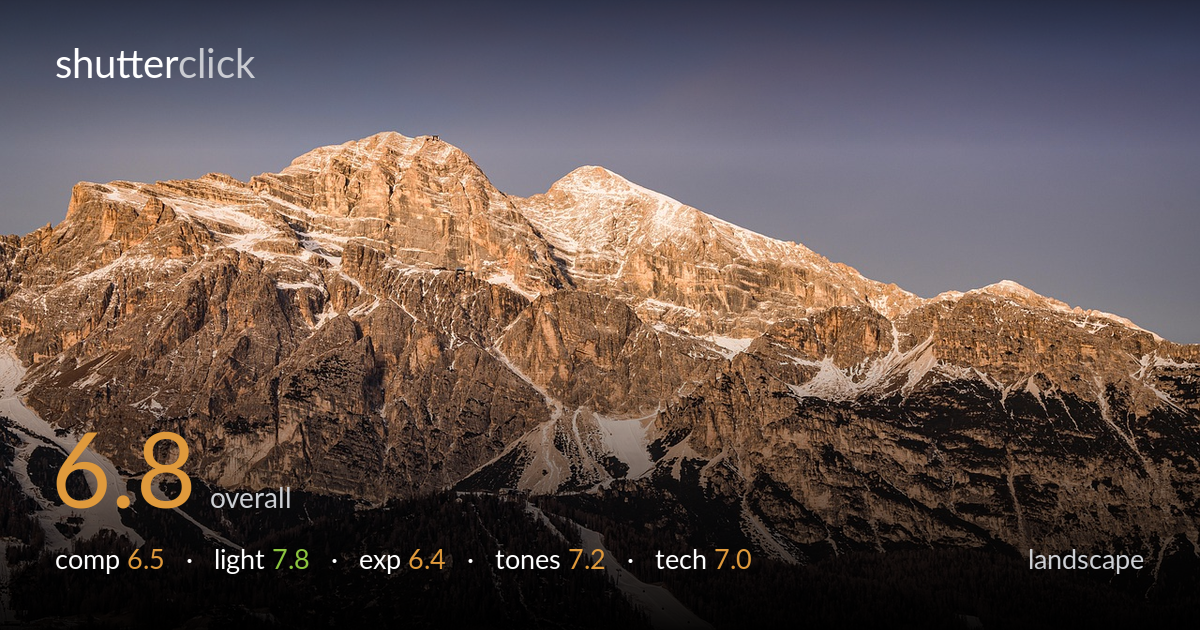
Warm alpine alpenglow peaks
Photo by MARTINOPHUC

No EXIF metadata in this file
Technical analysis based on visual assessment only.
Warm alpenglow on the Dolomite faces is the strongest asset here, catching the rock with a golden directional light that separates the lit peaks from the cool sky. What most holds the image back is the foreground: the dark forested slopes occupy the lower third with little detail or interest, anchoring nothing and reading as a heavy black band. The horizon sits roughly mid-frame, splitting sky and mountain without a clear hierarchy. A cleaner foreground element or a different vantage with depth would lift this from a competent record shot toward something with genuine pull. The light and tonal palette already do most of the work.
The twin peaks anchor the frame and the ridgeline carries the eye left to right, which works. But the mountain mass sits centrally with the horizon near the vertical midpoint, leaving a large expanse of plain sky above and a dark, featureless forest band below that contributes little. The lower third reads as dead weight rather than foreground interest. A crop trimming sky and a portion of the shadowed foothills would tighten the emphasis on the lit peaks, or a foreground element with detail would build depth and scale.
Low-angle golden-hour light is the picture's best quality, raking across the rock faces and revealing texture, fissures, and the snow-streaked gullies. The warm glow on the upper peaks against the cooling blue sky creates a pleasing temperature contrast typical of strong alpine work. The lit slopes have dimension and modelling. The trade-off is that the same low sun has thrown the foreground hills into deep, near-black shadow, collapsing detail there. Shooting a touch earlier, or from an angle catching more light on the lower slopes, would balance it.
The lit rock holds detail without clipping, and the sky gradation is intact, which suggests careful metering for the highlights. The cost is the foreground: the forested foothills sink into crushed shadow with very little recoverable information, reading as a flat dark mass. This is a wide dynamic range scene, and the exposure favoured the bright peaks at the shadows' expense. Bracketing and blending, or lifting shadows from a RAW file, would recover texture in the lower slopes without compromising the well-held highlights.
The warm-cool split is handled well: golden ochre on the sunlit rock against a graded blue-to-mauve sky gives the image its alpine character. Saturation looks natural rather than pushed, and the rock tones are believable. The sky carries a subtle vertical gradient that feels authentic to the hour. The main tonal weakness is the foreground shadows, which go muddy and lifeless rather than retaining cool detail. A gentle shadow lift with a touch of cool tint there would let the dark mass breathe and complement the warm peaks.
Sharpness across the rock faces is good, with the texture of the limestone and snow gullies rendered crisply, indicating accurate focus on the main subject and a sensible aperture for front-to-back depth at this distance. No obvious motion blur or camera shake. Noise appears controlled in the midtones, though the deep foreground shadows would likely reveal noise if lifted, suggesting headroom was limited there. The apparent focal length compresses the scene nicely, stacking the peaks against the foothills. The framing decision to include so much plain sky and shadowed foreground is the chief execution issue rather than any gear fault. Overall the capture is technically sound and clean; the file appears to hold enough detail in the lit areas to support a crop or tonal rework. A polarising filter could have deepened the sky and cut some atmospheric haze on the distant ridges, adding a little more snap to the separation between rock and air.
What would elevate it
Tags
Shot something like this?
Expert photo critique, on demand — scored across six categories, EXIF-aware. Start with 3 free critiques, no credit card.
critique my photo — free