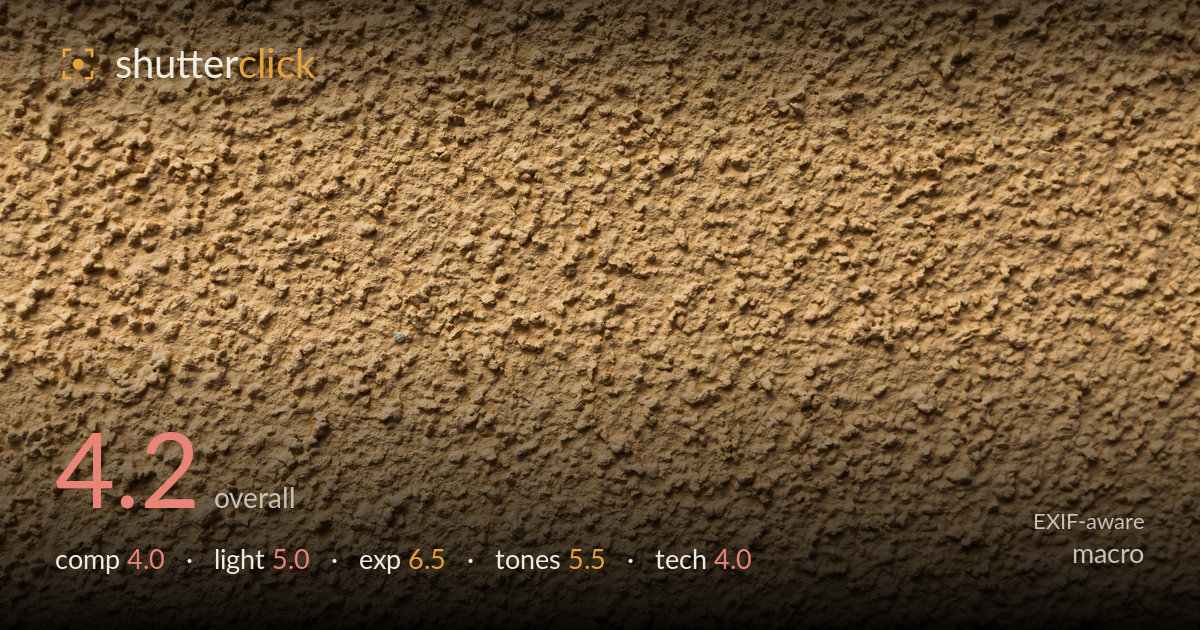
Warm textured stucco wall
Photo by Another one of my pictures: This photograph was taken by Medium69 (William Cr

| Focal length | 24 mm |
| Aperture | f / 2.8 |
| Shutter | 1/2500 s |
| ISO | ISO 100 |
| Exp. comp. | 0.0 EV |
| Shot at | 14:40 · Apr 5, 2015 |
This is a flat, evenly lit texture study of a rendered stucco wall rather than a macro image in the working sense. As a texture reference it does its job: the aggregate grain is legible across the frame and the exposure holds detail. But there is no focal point, no isolated subject, and the raking light needed to make this surface come alive is missing. The 24mm setting at f/2.8 is not a macro configuration, so fine relief stays muted. As a seamless tile or backdrop asset it functions; as a photograph with intent, it needs a subject, directional light, and genuine close-focus magnification.
The frame is a uniform field with no anchor, hierarchy, or point of entry for the eye. That flatness is deliberate for a texture asset, but as a photograph it reads as undifferentiated fill. There is a faint tonal gradient, brighter upper-right to shadowed lower-left, that gives the only sense of direction, and it is not used compositionally. A dominant grain cluster, an edge, or a foreign element placed off-centre would give the pattern something to organise around and turn repetition into rhythm.
The light is soft, near-frontal, and diffuse, which is the opposite of what a rough surface wants. Stucco lives on relief, and only low, raking side light carves the bumps and pits into readable form. Here the shadows are shallow and the aggregate looks flatter than it physically is. There is a mild falloff toward the lower-left corner, the only modelling present. Hard light skimming across the wall would transform this from a flat swatch into a landscape of texture.
Exposure is the strongest technical aspect. The midtones sit comfortably, highlights on the raised grains hold without clipping, and the recesses retain shadow detail, so the full micro-texture stays legible. ISO 100 keeps the file clean. The overall reading is slightly bright and low in local contrast, which flattens the surface further, but nothing is blown or crushed. A touch of negative exposure compensation would have deepened the pits and added the separation the flat lighting fails to provide.
The palette is a narrow band of warm ochre and tan, consistent and believable for a sun-toned render. White balance leans warm, reinforcing the earthy read, though it verges on monotony given the absence of any tonal contrast. The gradation across the grain is smooth but compressed, and saturation is restrained and natural. A wider tonal spread, either through harder light or added local contrast, would give the mid-tones more life and keep the whole frame from settling into a single flat colour note.
The EXIF explains most of the shortcomings. At 24mm on the EF 24-70, this is the wide end of a standard zoom, not a macro focal length, so there is no real magnification and the fine relief of the stucco is rendered small and muted rather than filling the frame with detail. Focus appears set to a general plane and, at f/2.8, depth of field on a flat wall shot parallel is adequate, but that wide aperture offers no benefit here and risks softness at the corners if the sensor plane is not perfectly parallel. Stopping to f/8 to f/11 would have secured edge-to-edge sharpness across the whole surface, which is exactly what a texture study needs. Shutter at 1/2500s and ISO 100 are effectively wasted on a static subject; a tripod, a longer exposure, and a smaller aperture would have been the correct trade. For true macro work, a dedicated macro lens or extension tubes at the long end would deliver the magnification this genre calls for.
What would elevate it
Tags
Shot something like this?
Expert photo critique, on demand — scored across six categories, EXIF-aware. Start with 3 free critiques, no credit card.
critique my photo — free