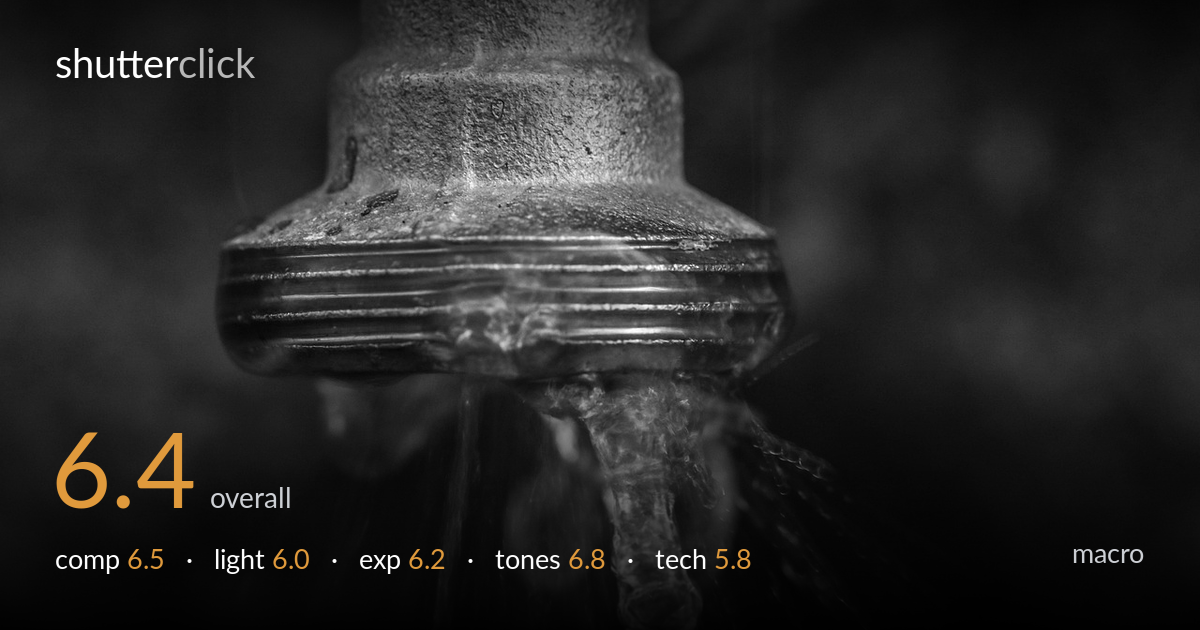
Water dripping from an old spigot
Photo by Photorama

No EXIF metadata in this file
Technical analysis based on visual assessment only.
A water spigot caught mid-spray makes a strong, tactile macro subject, and the monochrome treatment suits the metal and water well. The grooved ridge of the fitting holds genuine detail and the dark, mottled background isolates it cleanly. What most holds the image back is the focus plane: the sharpest detail sits on the upper body of the fixture, while the dripping water and spray streaks below — arguably the moment's real subject — fall soft. The composition crowds the top and leaves the spray reaching out of the frame edges without resolution. Tightening focus on the water and steadying the frame would lift this considerably.
The fitting anchors the upper-left third and the spray fans out below it, giving a reasonable sense of motion and direction. The dark surround does its job isolating the metal. But the fixture is cropped hard at the top, cutting the form before it resolves, and the spray streaks run off the right and bottom edges without a clear endpoint. A little more breathing room above and a frame that contained the spray's reach would give the eye somewhere to settle rather than drifting out of bounds.
Light rakes across the fitting from the upper area, picking out the concentric grooves on the ridge and the rough cast texture on the body — that directional quality is the image's strength. The water catches enough light to read as translucent. The background, however, sits in near-uniform shadow with little shaping, and the spray below loses brilliance, going muddy rather than sparkling. A touch more backlight or rim light on the water droplets would make the spray read as the luminous subject it wants to be.
Exposure is broadly controlled: the metal holds detail without blowing out, and the dark background keeps shadow density without crushing entirely to black. The brightest specular highlights on the wet ridge stay just shy of clipping. The lower half drifts dark, and the water spray loses tonal separation there, reading as a flat grey rather than discrete droplets. Lifting the shadows slightly in that zone, or exposing a half stop brighter, would recover the spray's structure without sacrificing the moody backdrop.
The black-and-white conversion is the most assured aspect here. Mid-tones on the cast fitting gradate smoothly across the rough surface, and the contrast is judged to keep both metallic sheen and shadow depth. Highlight roll-off on the wet ridge is graceful rather than harsh. The background's mottled greys add atmosphere without distraction. The only weakness is the lower frame, where tones compress into an undifferentiated dark grey and the spray loses the tonal range that defines it elsewhere in the frame.
The critical issue is focus placement. The sharpest plane lands on the upper body and grooved ridge of the fixture, while the dripping water column and the spray streaks below — the dynamic element that gives the shot its reason to exist — sit noticeably soft. For a macro of moving water, the focus wants to be locked on the water itself, ideally with a shutter fast enough to freeze the individual droplets that here blur into streaks. The streaking suggests either a slower shutter than the subject demanded or motion the focus couldn't hold. Depth of field is shallow, which suits the isolation but leaves little margin for error on the key plane. Noise is well controlled and the background bokeh is smooth and unobtrusive. A higher shutter speed, focus pulled forward onto the spray, and a slightly stopped-down aperture to extend the in-focus zone over the water would transform the technical execution.
What would elevate it
Tags
Shot something like this?
Expert photo critique, on demand — scored across six categories, EXIF-aware. Start with 3 free critiques, no credit card.
critique my photo — free