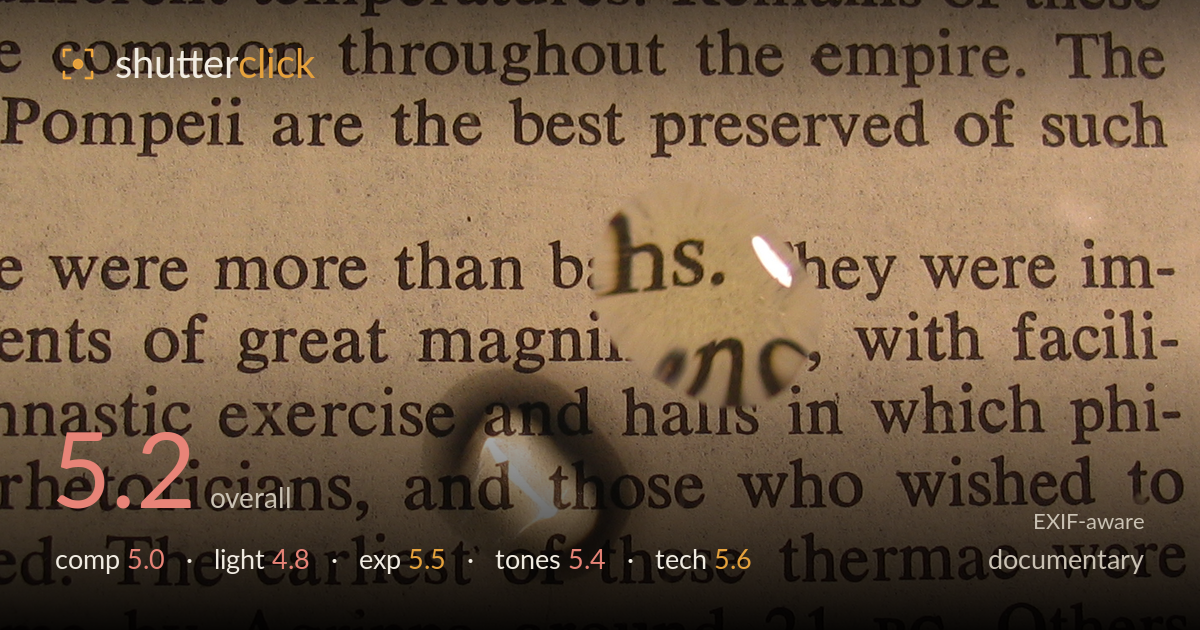
Water droplets magnifying printed text
Photo by Roger McLassus

| Focal length | 7 mm |
| Aperture | f / 2.8 |
| Shutter | 1/50 s |
| Exp. comp. | 0.0 EV |
| Shot at | 21:39 · Dec 25, 2005 |
The image reads as a study of water droplets magnifying printed text about Roman baths — a conceptually tidy pairing of subject and refraction. The larger droplet distorts and magnifies letters convincingly, and the coincidence of 'baths' appearing under the lens is a small visual reward. What holds it back most is a lack of clear intent: the frame is dominated by unmagnified text, the droplets sit off-centre without strong placement logic, and the specular highlights blow out. The concept is stronger than its execution. Tighter framing on the refracting droplets and softer, more even light would let the optical effect carry the shot.
The frame is dominated by flat, unmagnified text, with the two droplets occupying the middle band rather than commanding the composition. The larger droplet's magnified word sits high-right, the wet smear lower-centre — a loose, unresolved balance that leaves the eye wandering across body copy. The refracting droplets are the actual subject and deserve far more of the frame. As it stands, the text-to-effect ratio dilutes the idea. A tighter crop isolating the droplets, or deliberate placement of the magnified word on a thirds intersection, would give the optical trick the weight it needs.
The light is hard and single-sourced, producing bright specular pinpoints inside both droplets that clip to pure white and pull attention from the magnification effect. That glint can be a feature, but here it dominates and hollows out the droplet centre where the refracted text should read cleanest. The angle also flattens the surrounding paper, offering little to model the droplet's dome. Softer, more diffuse illumination — or repositioning the light so the specular sits at the droplet edge — would preserve the magnified letters and let the refraction, not the highlight, be the story.
Overall exposure holds the warm paper and dark type in a workable range, but the droplet highlights are fully clipped with no recoverable detail, and those blown cores sit right where the interesting refraction lives. The body text is legible and midtones are placed reasonably, so the base exposure is sound. The problem is dynamic range: the specular points exceed the sensor's headroom. A slightly darker exposure, or bracketing to protect the highlights, would keep the droplet interiors intact — the one area where detail actually matters here.
The warm cream paper and brown type give a consistent, document-appropriate palette, and white balance leans warm in a way that suits the aged-print feel. Contrast between text and background is adequate for legibility. The magnifying smear introduces a slightly milky, greenish cast that reads as flat and lifeless rather than intentional. Tonal separation within the droplets is minimal because the highlights clip. A touch more midtone contrast in the wet areas, and reining in the greenish tint of the smear, would make the refracted regions feel more deliberate and less like an accident on the page.
At 7mm and f/2.8 on the G5's small sensor, depth of field is generous, and both the flat page and droplet surfaces are acceptably sharp — focus lands on the text plane rather than the refracted image inside the droplet, which is a subtle miss for a shot about magnification. 1/50s handheld at this focal length is fine for a static page, and there's no visible motion blur. ISO appears low with clean shadows. The real limitation is optical: this compact struggles to resolve the fine refracted letters crisply, and the specular highlights overwhelm the sensor's dynamic range. A macro-capable setup, or moving in closer with the lens focused on the droplet's magnified content rather than the surrounding paper, would sharpen the actual subject. Stopping down slightly would deepen the droplet-to-page focus overlap. As shot, the settings are reasonable for a document grab but underserve the more ambitious refraction idea.
What would elevate it
Tags
Shot something like this?
Expert photo critique, on demand — scored across six categories, EXIF-aware. Start with 3 free critiques, no credit card.
critique my photo — free