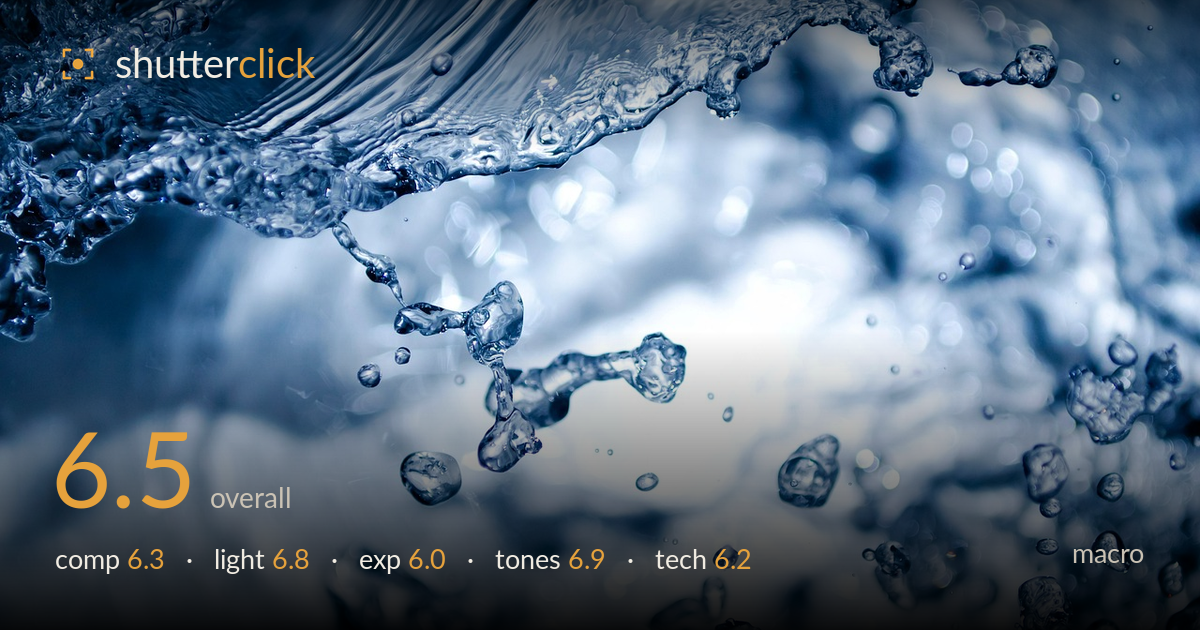
Water splash caught mid-flight
Photo by PublicDomainPictures

No EXIF metadata in this file
Technical analysis based on visual assessment only.
A high-energy water splash caught with genuine momentum, the arcing sheet at the top and the trailing droplets giving the frame real motion. The blue-toned treatment reads clean and refreshing. What most holds it back is focus placement: the sharpest detail sits in the upper splash while the airborne droplets through the centre soften, leaving no single anchor for the eye. The bright central highlight also pulls attention away from the water forms and edges toward clipping. Tightening focus on a defined plane and taming that hotspot would lift this from a pleasant abstract splash to a controlled, intentional macro study.
The diagonal sweep of the water sheet across the top third gives the frame direction, and the scattered droplets carry the eye downward with pleasing rhythm. But the arrangement lacks a clear focal anchor — attention drifts between the top arc and the mid-frame droplets without settling. The bright hotspot slightly right of centre competes with the water forms rather than supporting them. A composition that placed the sharpest, most sculptural droplet cluster against a cleaner, darker patch of background would give the eye somewhere decisive to land.
Backlighting is the right instinct here — it rims the droplets and lets the water glow with translucency, which is exactly what makes splash imagery read. The soft, diffuse quality keeps the water forms rounded rather than harsh. The weakness is the concentrated bright core behind the central droplets, which flares toward pure white and flattens the tonal separation in that region. A slightly more even backlight, or a scrim to soften that hotspot, would preserve the glow while keeping detail in the brightest droplets.
Exposure is broadly workable but pushed bright in the centre, where the backlit highlight approaches clipping and loses droplet detail against the glow. The upper-left water sheet holds midtone detail well, and the darker droplets retain form. The overall high-key handling suits the airy, refreshing subject, but pulling exposure down by a fraction would recover texture in that blown core and give the whole frame more tonal substance. As it stands the brightest zone reads as empty rather than luminous.
The cool blue grade is well judged for water — it reinforces the clean, refreshing mood and gives the frame a cohesive identity. Tonal range runs from deep blue shadows in the droplets to bright near-white highlights, a decent spread. The blue can feel slightly monochromatic and heavy-handed in the darker droplet cores, edging toward flat. A touch more tonal separation in the midtones, or a hint of warmth to offset the uniform cool cast, would add dimension without losing the aquatic character.
The freeze on the water is the strongest technical element — a fast shutter has arrested the airborne droplets cleanly, holding the splash's shape mid-flight, which is the hardest part of this kind of shot. Where it falters is focus placement and depth of field. The sharpest plane sits on the upper water sheet, while the mid-frame droplets — arguably the more interesting subjects — fall just soft, and the shallow depth means only a thin slice is critically sharp. For a macro splash, focus needs to land decisively on the key droplet cluster. A marginally smaller aperture would extend the sharp zone across more of the airborne water, and pre-focusing on the anticipated splash path rather than the background sheet would put the crispness where the eye wants it. Noise is well controlled and the rendering is clean. The execution shows the reflexes and timing this genre demands; it is the precision of the focus plane that needs the final refinement.
What would elevate it
Tags
Shot something like this?
Expert photo critique, on demand — scored across six categories, EXIF-aware. Start with 3 free critiques, no credit card.
critique my photo — free