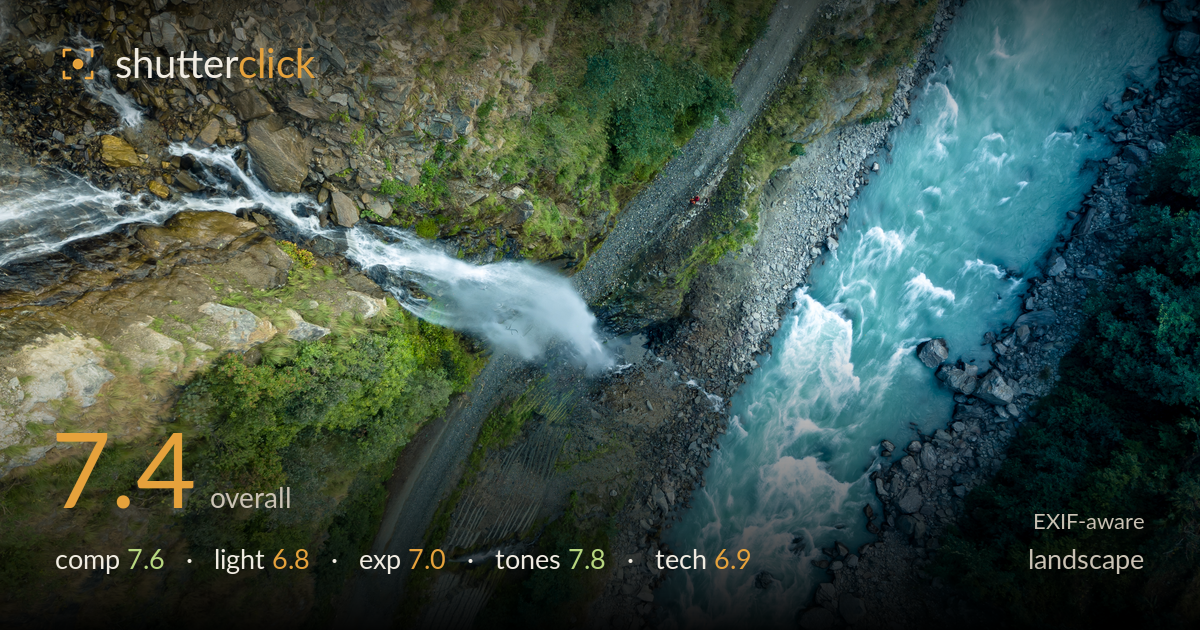
Waterfall meeting a glacial river
Photo by Nammy Hang Kirat

| Focal length | 5 mm |
| Aperture | f / 2.2 |
| Shutter | 1/13 s |
| ISO | ISO 141 |
| Exp. comp. | 1.0 EV |
| Shot at | 08:04 · Oct 18, 2018 |
A strong top-down aerial that turns the meeting of waterfall, gravel road and glacial river into a natural diagonal. The turquoise water against warm rock and green vegetation carries genuine graphic energy, and the waterfall spray adds a soft motion accent against the churning rapids. What holds it back is the busy left third — the dry riverbed and rockfall read as cluttered next to the crisp river on the right, so the frame feels weighted unevenly. Flat overhead light also mutes the rock texture. A more considered balance of the two halves and firmer critical sharpness would lift it further.
The nadir perspective works, using the diagonal split of river, road and waterfall to divide the frame into competing textures — a smart way to build tension. The turquoise river anchors the right, the waterfall spray provides a focal accent near centre. The weakness is imbalance: the left third piles up dry rockfall and pale riverbed that reads as visual clutter against the clean flow opposite. A slight reframe or rotation to let the diagonal run corner-to-corner more decisively would tighten the geometry and calm the busier side.
The light is soft and even, typical of overcast or open shade from altitude, which keeps the turquoise water saturated and avoids blown highlights on the whitewater — a real benefit here. The trade-off is flatness: the rock faces and gravel lack the raking shadow that would reveal relief and depth, so the terrain reads slightly two-dimensional. Directional low-angle light, earlier or later in the day, would carve texture into the rock and give the scene more sculptural dimensionality without threatening the river colour.
Exposure is well controlled for a high-contrast scene. The bright whitewater retains texture rather than clipping, and the darker wet rock near the waterfall keeps detail. The +1.0 EV compensation looks justified against the dark rock, though it pushes the brightest foam close to the ceiling in places. Midtones in the vegetation and gravel sit comfortably. Shadow areas under the cliff edge on the left are a touch dense but recoverable. Overall a deliberate, balanced rendering across a demanding dynamic range.
The colour is the standout: glacial turquoise plays beautifully against warm ochre rock and cool green foliage, a naturally complementary palette given room to breathe. White balance reads accurate — the water looks convincingly cold rather than over-teal. Contrast is measured, holding both foam highlights and rock shadow. If anything the greens verge slightly toward the electric, and a hair more separation between the road's grey and surrounding rock would help. Restrained, cohesive grading that serves the scene rather than overwhelming it.
Shot on the DJI FC220 (Phantom-series drone) at its native 5mm f/2.2, ISO 141, 1/13s. The low ISO keeps noise negligible and the small sensor's fixed aperture is fine at this focal length, where depth of field is effectively total for a nadir landscape. The concern is the 1/13s shutter from an airborne platform: it's slow enough to risk drift blur, and while it softly renders the waterfall spray nicely, the surrounding rock detail looks marginally less crisp than a stable frame should deliver. A faster shutter, even at slightly higher ISO, would guarantee edge-to-edge bite from the small sensor while still letting the water carry some motion. The wide fixed lens suits the top-down survey and the framing exploits it well. Focus is essentially fixed at infinity and adequate, but critical sharpness across the rock is the limiting factor rather than the exposure math, which is sound.
What would elevate it
Tags
Shot something like this?
Expert photo critique, on demand — scored across six categories, EXIF-aware. Start with 3 free critiques, no credit card.
critique my photo — free