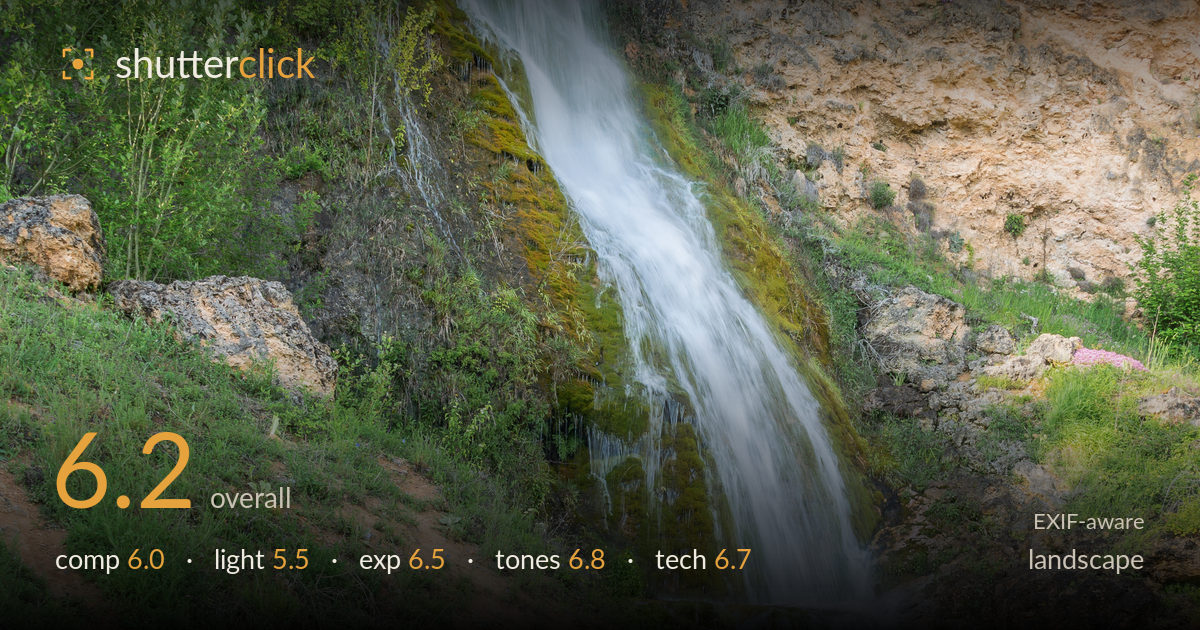
Waterfall over mossy rocks
Photo by Krzysztof Golik

| Focal length | 23 mm |
| Aperture | f / 11.0 |
| Shutter | 1/25 s |
| ISO | ISO 100 |
| Exp. comp. | 0.0 EV |
| Shot at | 19:28 · May 26, 2019 |
A pleasant roadside waterfall let down mostly by flat midday light and a busy lower foreground. The silky water rendering is the strongest element, and the vertical framing suits the cascade's diagonal descent. What most holds the frame back is the harsh, high-contrast daylight that hardens the rock and washes the sky, plus the large expanse of grey tarmac at the bottom that adds no interest. Tighter attention to the base of the falls and softer light would lift this considerably. The composition has a good backbone; it just needs cleaner edges and better light to fully deliver.
The vertical format works well for the cascade, and the diagonal flow from top-left down to the pool gives the frame a natural line to follow. The falls sit slightly right of centre, which is fine. The problem is the bottom third: a broad wedge of featureless grey tarmac occupies foreground space that contributes nothing and pulls weight away from the water. The green foliage framing the left edge is a strength. A tighter crop excluding the road, or a lower angle emphasising the stone wall and pool, would strengthen the base.
This is the weakest area. The scene appears shot under bright, near-overhead midday sun, producing hard contrast on the rock face, blown highlights in the sky, and little modelling in the water. The dappled sun on the tarmac confirms harsh directional light. Overcast conditions or the softer angle of early morning would tame the contrast, reveal texture in the tufa and moss, and let the white water hold detail rather than clipping. As it stands, the light flattens the tonal separation between water and pale rock.
Exposure is handled reasonably given the difficult contrast range. The white water retains some detail in most areas, though the brightest cascades near the base begin to clip. Shadow detail in the foliage and rock crevices is preserved without muddiness. The sky is the casualty — pale and near-featureless top-right, a consequence of the light rather than metering error. The midtones in the grass and stone are well placed. A graduated approach or bracketing would have salvaged the highlight-heavy water and sky.
The colour rendering is the more successful side. The spring greens are vibrant without oversaturation, and the warm ochre of the tufa rock balances nicely against the foliage. White balance sits neutral and believable. Contrast is a touch high, again driven by the light, which pushes the moss shadows dark and the water bright. The small pink and purple wildflowers add welcome colour accents. The grey tarmac at the base introduces a dead, cool tone that clashes with the otherwise warm palette.
The settings are well chosen for the situation. At f/11 the depth of field carries sharpness front to back, appropriate for a landscape at this distance, and diffraction is not yet a real concern on this sensor. ISO 100 keeps noise absent and preserves clean tonality. The 1/25s shutter is the key decision — it blurs the water into a soft, silky ribbon while keeping the surrounding rock and foliage acceptably sharp, suggesting either a stable support or careful handholding at 23mm. Focus lands well on the mid-cascade and rock. The Tamron 18-270 is a convenience superzoom and not the sharpest optic, and some softness in the fine foliage detail reflects that, but at f/11 the centre holds up. A slightly longer shutter, around 1/6 to 1/2s with an ND filter, would have smoothed the water further for a more dramatic effect. Solid technical execution overall.
What would elevate it
Tags
Shot something like this?
Expert photo critique, on demand — scored across six categories, EXIF-aware. Start with 3 free critiques, no credit card.
critique my photo — free