Waterfall through the pines
Photo by Uoaei1

| Focal length | 80 mm |
| Aperture | f / 8.0 |
| Shutter | 1/1500 s |
| ISO | ISO 100 |
| Exp. comp. | -2.0 EV |
| Shot at | 12:52 · Aug 17, 2021 |
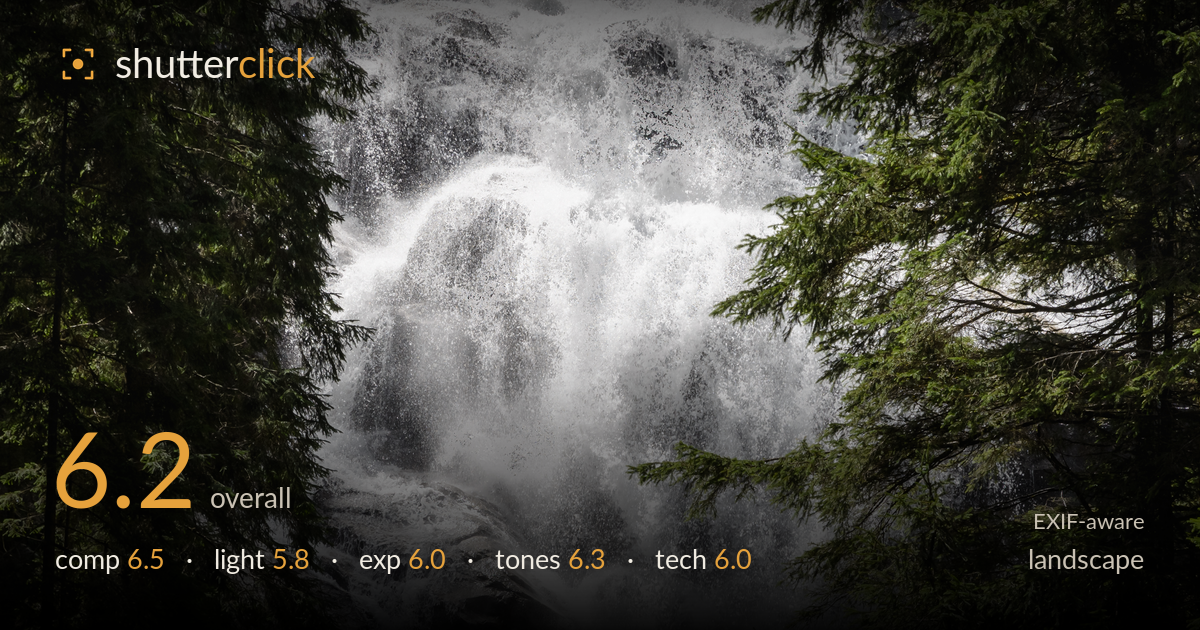
A waterfall framed through a gap in the conifers — the natural window of foreground trees is the strongest compositional idea here, funnelling the eye down the cascade. What most holds it back is the fast shutter. At 1/1500s the water is frozen into a spray of chaotic droplets rather than the flowing veil this subject invites, and the harsh dappled sunlight blows the white cascade toward clipping while the surrounding rock and forest sit heavy and dark. The vertical flow and the layered drops read well, but the light and motion rendering leave the frame busier and flatter than the scene deserves.
The framing device of dark conifer boughs on both sides creates a natural window that concentrates attention on the cascade — a genuine strength. The waterfall's diagonal descent from upper-left gives the frame movement and the stacked ledges build depth. The overhanging branch top-right intrudes a little and the foreground rock at the base is cut awkwardly. The waterfall sits slightly right of centre, which works, but the top third of tumbling water competes with the main drop rather than clearly subordinating to it.
Harsh midday sun filtering through the canopy is the core problem. The dappled light throws bright hotspots across the white water while leaving the rock faces and forest in deep shade, creating a high-contrast, patchy look that flattens the scene's dimensionality. There's no shaping quality to the light on the cascade — it simply blasts the spray white. Overcast conditions or shooting when the falls sit in open shade would have tamed the contrast and let the water's structure and the rock texture read far more evenly.
The -2 EV compensation was a sensible move to protect the bright water, and the brightest cascade areas mostly hold detail rather than clipping to pure white. The trade-off is that the shadowed rock and surrounding forest fall very dark, losing texture in the lower and edge regions. The dynamic range of dappled sun on white water against black shade is punishing, and the exposure sits nearer the highlights than the middle. Bracketing or a raw lift of the shadows would recover the rock detail the scene needs.
The green-and-grey palette is natural and the white balance reads neutral. The whites of the water carry a slight muddiness rather than crisp brightness, and the conifer greens are dense and a little flat in the shadows. Contrast is high by circumstance, pushing mid-tones toward the extremes and hollowing out the tonal gradation in the rock. A gentler contrast curve with lifted shadows and a touch more separation in the greens would give the frame more tonal breathing room and depth.
At 80mm, f/8, ISO 100 the exposure triangle is well chosen for a bright scene — f/8 delivers sharp depth across the falls and low ISO keeps noise absent. Focus lands accurately on the cascade. The clear misstep is the 1/1500s shutter: for a waterfall it freezes the water into a stippled mass of frozen droplets rather than rendering the silky or textured flow that gives falling water its character. A shutter of 1/4 to 1s, which would have required a tripod and likely a neutral-density filter given the daylight, would transform the water's rendering entirely. The gear was capable of it — the 16-80 stopped to f/8 and ISO 100 is the right base, and adding an ND filter would let the shutter drop without overexposure. Sharpness and depth of field are otherwise handled well; motion rendering is the single limiting technical choice here.
What would elevate it
Tags
Shot something like this?
Expert photo critique, on demand — scored across six categories, EXIF-aware. Start with 3 free critiques, no credit card.
critique my photo — free