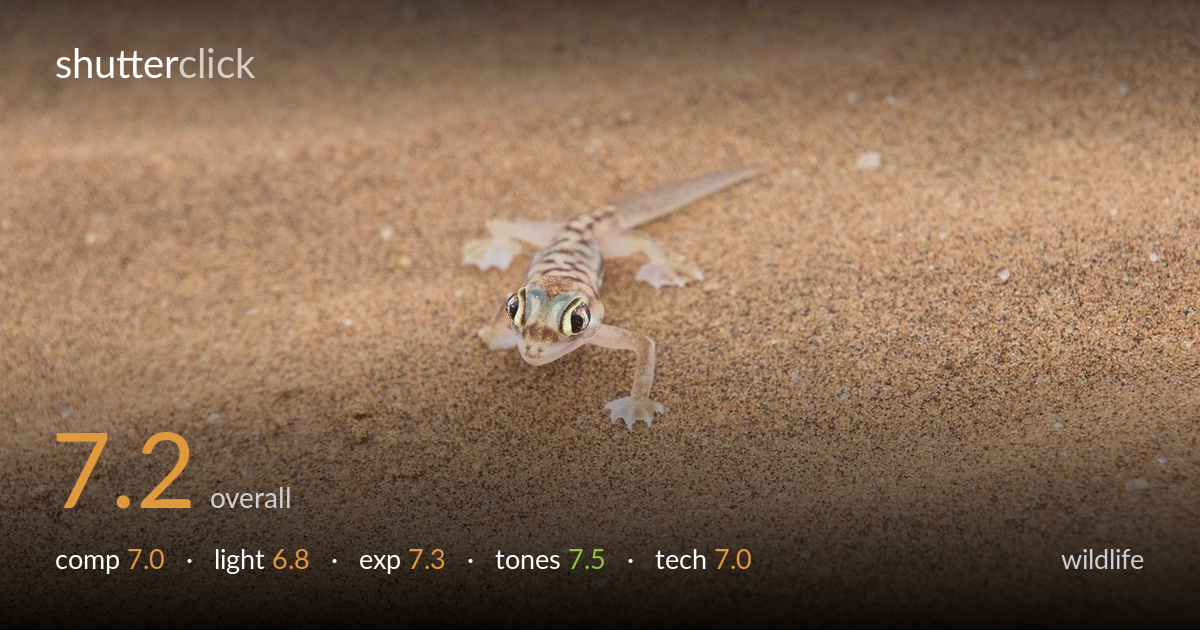
Web-footed gecko on desert sand
Photo by Royber99

No EXIF metadata in this file
Technical analysis based on visual assessment only.
A charming eye-level encounter with a web-footed gecko, and the low angle is the photograph's biggest asset — meeting the animal in its own world rather than looking down on it. The frontal stare and translucent feet read clearly, and the warm sand tones unify everything beautifully. What most holds it back is focus precision: the eyes, which must be the sharpest point in any wildlife frame, sit slightly soft, and the head's near-central placement leaves the composition a touch static. Tightened framing and critical eye focus would lift this from pleasant to striking.
The low, eye-level perspective is the strongest decision here, placing the viewer in the gecko's world across an expansive sweep of sand. The subject sits near centre, which feels static; shifting it onto a thirds intersection with the gaze leading into negative space would add tension. The diagonal of the tail counters the frontal body nicely. The vast sand foreground works as habitat context but borders on empty in the lower frame — a marginally tighter crop would concentrate attention on the animal and its trailing tail.
Soft, diffused light spreads evenly across the scene, likely overcast or shaded, which keeps the sand's warm tone gentle and avoids harsh blown highlights on the pale body. The trade-off is a lack of modelling: the gecko reads a little flat, with minimal shadow to separate it from the similarly toned sand. Low, raking side light would carve out the scaled texture and the translucent feet, and lend the grains of sand more dimension. As shot, the light is clean but undramatic.
Exposure is well controlled for a bright, light-toned scene that could easily fool a meter. The sand retains highlight detail without clipping, and the gecko's pale body holds tonal information rather than washing out. Shadows under the feet and chin stay open with detail intact. Midtones sit comfortably, giving the histogram a healthy spread weighted to the brighter end as the subject demands. Nothing here looks accidental — the brightness reads as a deliberate, accurate rendering of a high-key desert surface.
The warm, sandy palette is the photograph's quiet strength — a coherent range of ochres and tans that flatter the gecko's matching camouflage. White balance looks accurate, neither too orange nor too cold. The subtle greens and pinks around the eye provide just enough contrast to draw the gaze. Saturation is restrained and natural. Tonal range is gentle by design, suiting the soft light, though a fraction more contrast on the animal itself would help it lift away from the near-identical background.
Depth of field is judged sensibly for this frontal pose — enough to hold the head and front feet while the background sand falls into pleasant blur, isolating the subject from an otherwise busy surface. The critical weakness is focus placement: the sharpest plane appears to sit on the snout and front legs rather than locking precisely on the eyes, which read marginally soft. In wildlife work the eye must be tack-sharp, and that small miss costs the frame its bite. Noise is well controlled and the image is clean at viewing size. The translucent webbed feet are rendered with good detail, a genuine highlight given how delicate they are. Shutter speed was clearly sufficient to freeze the static subject. Stopping down a touch more, or focusing fractionally further back onto the eye, would have brought the whole head into crisp register without sacrificing the background separation.
What would elevate it
Tags
Shot something like this?
Expert photo critique, on demand — scored across six categories, EXIF-aware. Start with 3 free critiques, no credit card.
critique my photo — free