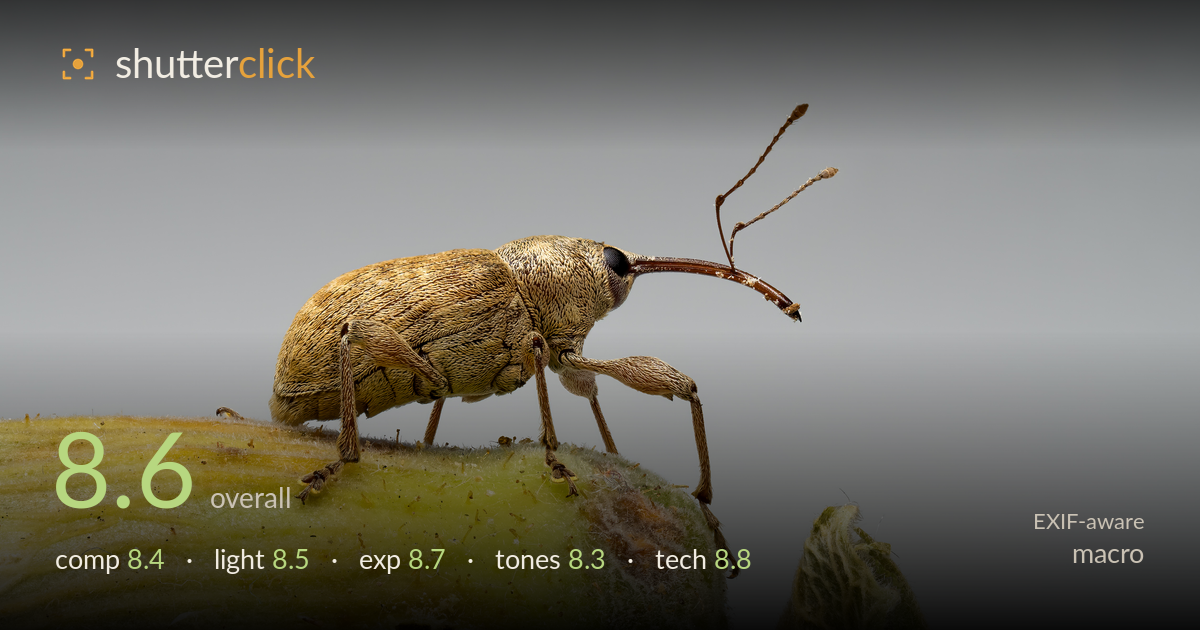
Weevil on a nibbled acorn
Photo by Ermell

| Focal length | 60 mm |
| Aperture | f / 5.6 |
| Shutter | 1/60 s |
| ISO | ISO 200 |
| Exp. comp. | 0.0 EV |
| Shot at | 09:04 · Aug 8, 2022 |
A textbook weevil profile with exceptional focus discipline across a deep subject — the classic side-on pose reads instantly and the narrative detail of the bore hole in the acorn ties the scene together. The clean gradient background isolates the subject without distraction. What holds it back most is the antenna tips brushing the top edge, which crowds the frame and clips the composition's breathing room. The greens run slightly murky in the foreground, and the acorn surface litter, while authentic, competes for attention. Small refinements in framing and a touch more foreground contrast would lift a very accomplished frame further.
The profile placement is strong — the weevil occupies the upper-left with its snout and antennae leading right into negative space, a natural reading path. The acorn anchors the lower third and the bore hole adds story. The main weakness is the antennae reaching almost to the top edge; a little more headroom would let them breathe rather than feel pinned. The torn husk lower-right balances the weight nicely, though it slightly competes. Overall a confident, classic macro arrangement with clear subject hierarchy.
Soft, near-shadowless diffusion wraps the subject and reveals the fine punctate texture across the elytra and rostrum without harsh hotspots — well suited to a hairy, sculptured beetle. The catchlight in the eye adds life, and the light falls evenly enough to keep both near and far legs legible. It errs slightly flat; a touch more directional raking from the side would carve more three-dimensional relief into the body ridges. The acorn surface reads a little dull under this even wash, but the subject is handsomely lit.
Exposure is well judged — the pale grey backdrop sits clean without blowing out, and highlight detail holds across the beetle's back and the acorn skin. Shadows under the body and inside the bore hole retain information rather than blocking to black. The midtones on the elytra are placed to show every scale and puncture. Nothing clips meaningfully. If anything the overall level is a hair bright, muting some of the darker legs, but this is a deliberate, controlled exposure with excellent dynamic range use.
The warm ochre of the weevil against the cool neutral grey is a pleasing complementary pairing, and white balance reads accurate. The elytra tones show good gradation from tan to darker leg joints. Where it slips is the foreground green — it drifts toward a slightly muddy yellow-green with dust and debris flattening its vibrancy, and the torn husk browns feel a touch dull. A gentle lift in the acorn's saturation and clarity would give the base more presence to match the crisp subject rendering.
At f/5.6 on the 60mm macro, depth of field is intelligently managed — the entire weevil from front leg to rear elytra sits acceptably sharp, suggesting either a well-placed single plane or careful stacking, and the punctate texture resolves beautifully. ISO 200 keeps the file clean with no visible noise, ideal for this controlled setup. The 1/60s shutter is fine for a static subject on a stable rig, though it demands the beetle hold still and any breeze would have blurred those delicate antennae — they hold sharp, so timing worked. Focus on the eye is precise with a clear catchlight. The far legs and antenna tips soften slightly, consistent with the focal plane's limits at this magnification; a tighter stack would recover the leg extremities. The 60mm is well matched to the working distance for a subject of this size. Overall this is high-level macro execution — the settings are coherent, the focus discipline across a deep subject is the standout achievement.
What would elevate it
Tags
Shot something like this?
Expert photo critique, on demand — scored across six categories, EXIF-aware. Start with 3 free critiques, no credit card.
critique my photo — free