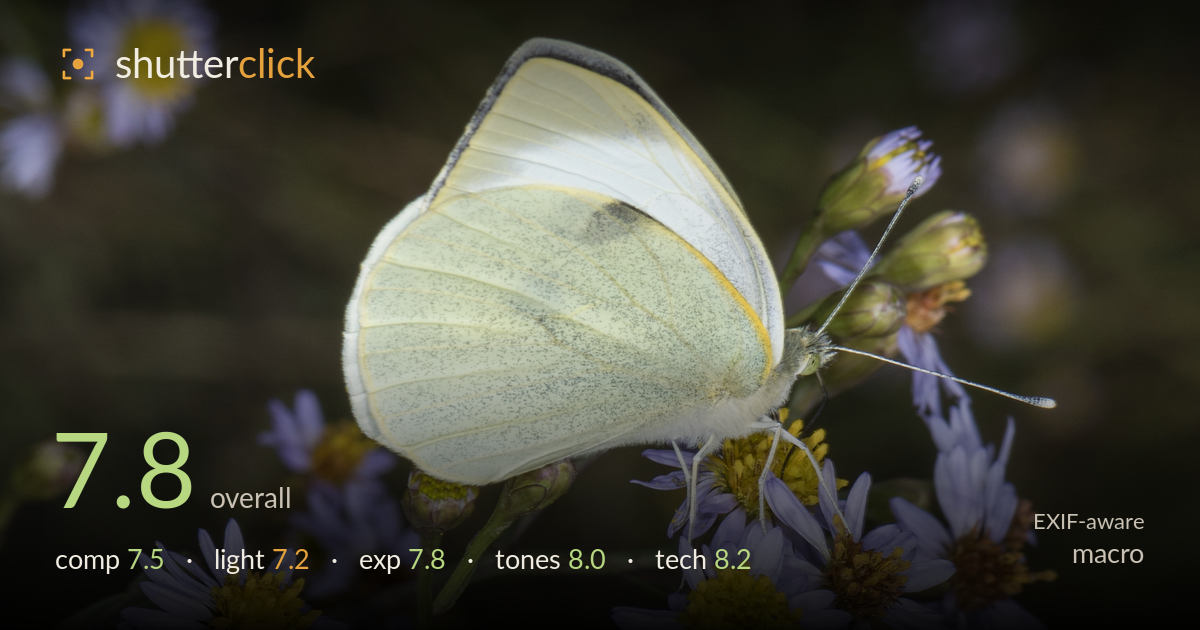
White butterfly on purple asters
Photo by Christian Ferrer

| Focal length | 105 mm |
| Aperture | f / 16.0 |
| Shutter | 1/250 s |
| ISO | ISO 100 |
| Exp. comp. | 0.0 EV |
| Shot at | 13:06 · Oct 4, 2015 |
A clean, well-executed macro of a white butterfly on purple asters, carried by strong technique and a pleasing colour relationship between the pale wings and lavender blooms. The wing surface is sharply resolved with fine scale detail, and the f/16 choice keeps the whole insect crisp against a softly rendered background. What holds it back most is the butterfly's placement high in the frame, leaving the top edge cramped while the busier cluster of flowers competes for attention below. The eye and antennae — the natural focal point — sit slightly softer than the wing. A stronger subject hierarchy and a touch more breathing room would lift this from competent to memorable.
The butterfly anchors the upper-left third and reads clearly against the dark background, with the aster cluster providing a supporting base. The wing's clean form is the strongest graphic element. But the subject sits high enough that the top wing edge nearly touches the frame edge, creating tension without purpose. The lower half is busy — multiple flowers and crossing stems compete for attention and dilute the hierarchy. A slightly lower subject placement, or a crop that gives the wing tip room to breathe, would resolve the crowding and let the butterfly dominate more decisively.
Soft, diffused light — likely overcast or shaded — renders the wing's subtle tonal gradations and fine speckling without harsh specular hotspots, which suits the delicate subject well. The direction is fairly flat, however, so the wing reads more as a clean surface than a form with dimension. A hint of raking side light would model the wing's curvature and lift texture on the flowers. The dark background benefits from the falloff, keeping the subject separated, but the overall lighting feels safe rather than shaping.
Exposure is well controlled for a bright subject against a dark field. The white wing holds detail throughout — the scale texture and faint veining survive without clipping, which is the hard part with a pale insect. Shadows in the background go deep but retain enough information to read as foliage rather than pure black. The yellow flower centres are saturated but not blown. Midtones on the green stems sit naturally. A touch more shadow lift would recover background context, but the current balance keeps attention firmly on the butterfly.
The colour palette is the image's quiet strength: cool cream wings against lavender petals and warm yellow centres form a natural complementary harmony that feels balanced, not gaudy. White balance is accurate — the whites stay neutral without a colour cast, and the greens read true. Saturation is restrained and believable, and the tonal range runs cleanly from the bright wing to the deep background. The subtle green speckling on the wing is faithfully rendered. Contrast is gentle and appropriate for the soft light, holding the delicate mood.
The f/16 aperture on the 105mm macro is a sound choice, delivering enough depth of field to hold the entire butterfly sharp from wing edge to body while still throwing the background into soft, non-distracting blur. Focus lands well on the wing surface, where scale detail and veining are crisply resolved. The 1/250s shutter froze the subject cleanly with no motion blur, and ISO 100 keeps the file noise-free with maximum tonal quality — ideal discipline for macro. The main technical shortfall is focus placement: the plane favours the near wing, leaving the eye, head, and antenna base slightly softer than the classic macro ideal of a tack-sharp eye. At f/16 diffraction also begins to very gently soften fine detail, so f/11 might have preserved marginally more critical sharpness while still covering the depth needed. A focus-stack of two or three frames would have brought both the wing and the head into equal crispness. Overall, technically assured work.
What would elevate it
Tags
Shot something like this?
Expert photo critique, on demand — scored across six categories, EXIF-aware. Start with 3 free critiques, no credit card.
critique my photo — free