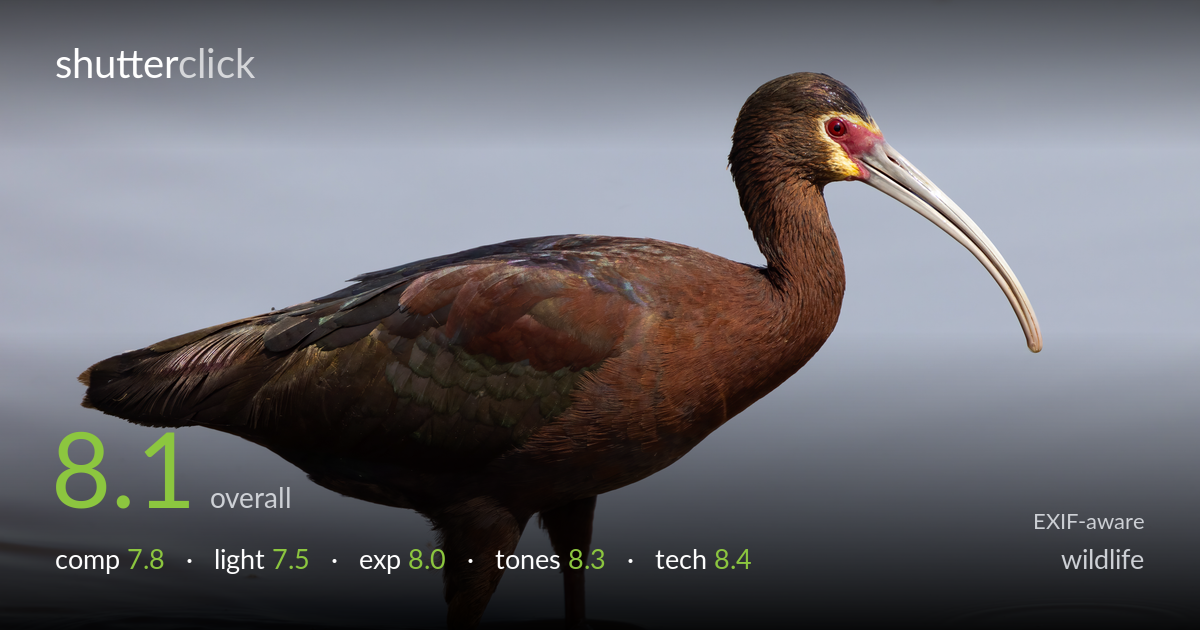
White-faced ibis wading at the water
Photo by Frank Schulenburg

| Focal length | 631 mm |
| Aperture | f / 10.0 |
| Shutter | 1/1000 s |
| ISO | ISO 400 |
| Exp. comp. | -0.33 EV |
| Shot at | 10:01 · Apr 24, 2022 |
A clean, technically assured portrait of a white-faced ibis wading, with the bird sharp against a smooth water backdrop and the iridescent plumage well rendered. The down-curved bill and red facial skin read clearly, and the concentric ripples add quiet life to the negative space. What most holds it back is the lighting: flat frontal light keeps the plumage from fully revealing its metallic sheen, and the bird sits slightly tight to the right frame edge, cramping the room ahead of the bill. The eye is sharp and the moment calm, making this a strong field result that small framing and timing adjustments would lift further.
The profile pose reads cleanly and the down-curved bill leads the eye, while the large expanse of calm water and concentric ripples give the bird room to breathe. The placement is slightly tight on the right, however — the bill and the space it points into press close to the frame edge, which constrains the forward momentum of the gaze. The low water-level perspective is excellent for intimacy. A touch more space ahead of the bill and a hair less behind the tail would balance the directional weight better.
Light is bright and even, lifting the red facial skin and the pale bill cleanly, and the catchlight in the eye is present. The trade-off is flatness: the near-frontal, high-angle light flattens the plumage and underplays the green-and-bronze iridescence that defines this species. Soft shadow on the breast and flank keeps detail but lacks the modelling that lower, raking light would bring. A lower sun angle, earlier or later in the day, would rake across the feathers and ignite the metallic sheen.
Exposure is well judged for a tricky tonal mix — the dark plumage retains feather detail without crushing into black, and the bright water holds gradation without clipping. The -0.33 EV compensation protected the highlights on the bill and the reflective surface sensibly. Shadow recovery in the breast looks natural rather than lifted. The pale bill tip sits near the top of the range but stays within detail. A balanced histogram for a subject that ranges from near-white bill to deep iridescent black.
The colour rendering is a strength: the maroon body, bronze-green wing coverts, and crimson facial skin are saturated convincingly without tipping into garishness. The cool blue-grey water sets off the warm bird tones nicely, and the muddy gold reflection at the bottom adds a grounding warmth. White balance reads accurate on the neutral bill. Contrast is gentle, suiting the soft light. The iridescent highlights could carry slightly more separation, but the tonal gradation across the dark plumage is handled well.
At 631mm with the 1.4x extender on the R5, this is demanding reach, and the execution holds up well. The eye is critically sharp with visible feather detail across the head and neck, and 1/1000s comfortably froze the stationary wading bird and the bill. ISO 400 keeps noise negligible and tonal smoothness intact. f/10 is a touch deep for pure subject isolation, but at this focal length it still renders the water as a clean, soft wash while keeping the full body within the plane of focus — a reasonable compromise given the bird's depth in profile. Focus landed precisely on the near eye. The only minor cost of f/10 is that a wider aperture, where the extender allows, would have softened the foreground ripples further and bought a slightly faster shutter as insurance. Overall the gear was used near its sweet spot and the result is a sharp, low-noise frame that does justice to the reach.
What would elevate it
Tags
Shot something like this?
Expert photo critique, on demand — scored across six categories, EXIF-aware. Start with 3 free critiques, no credit card.
critique my photo — free