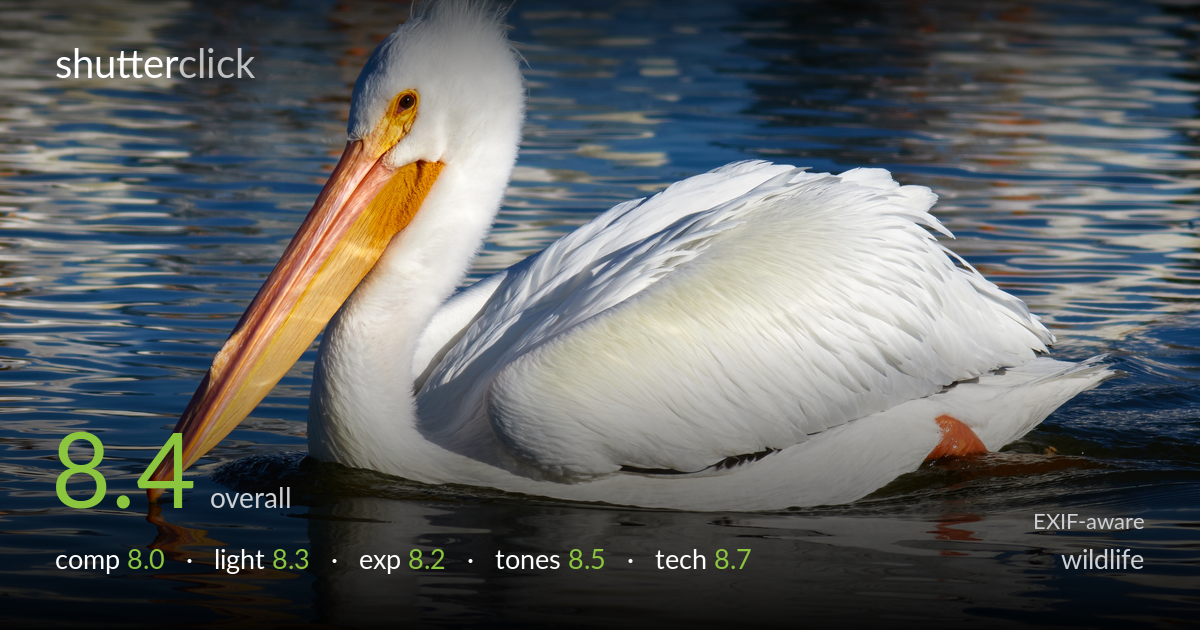
White pelican swimming
Photo by Frank Schulenburg

| Focal length | 560 mm |
| Aperture | f / 8.0 |
| Shutter | 1/1250 s |
| ISO | ISO 100 |
| Exp. comp. | -0.67 EV |
| Shot at | 09:56 · Jan 1, 2016 |
A clean, sharp profile of an American white pelican that nails the fundamentals: tack-sharp eye, beautiful low-angle light on the bill, and a rich blue water canvas with warm reflections. The bill tip kissing the surface adds a quiet narrative touch. What holds it back is a static, broadside pose at rest — pleasing but not a behavioural peak — and a composition that leaves the bird drifting slightly low and central with the bill nearly clipping the left edge. A touch more breathing room ahead of the bill and a moment of action would lift this from a strong portrait to a memorable wildlife frame.
The side-on profile reads cleanly against the rippled blue water, and the reflection of the bill anchors the lower frame nicely. The bird occupies a strong portion of the frame without crowding. The weakness is the bill tip pressing close to the left edge, which tightens the lead-in space the subject is moving into — a few centimetres more room ahead would relieve that tension. The subject also sits a little low and central; lifting it slightly or offsetting it would energise the balance. The eye falls near a thirds intersection, which works.
Low, warm directional light rakes across the bird from the front-left, lighting the bill and casting the head's plumes into soft relief. The orange glow on the bill is gorgeous and the light keeps the white feathers from going flat by preserving subtle tonal modeling along the back and flank. Shadow under the chin and wing gives form without going harsh. It reads as golden-hour or near it, which is exactly the window that flatters white birds — strong enough that the white holds texture rather than blowing out.
The -0.67 EV compensation was the right call for a bright white subject — it protects the highlights so the back and breast retain feather detail rather than clipping to paper white. A handful of the brightest sunlit feathers sit close to the ceiling but stay recoverable. Shadow areas under the wing and chin hold detail without muddiness, and the blue water sits at a pleasing mid-tone. Histogram usage looks deliberate and well managed for a high-key subject against a darker field. Clean, confident exposure judgement throughout.
The colour palette is the standout: deep saturated blues in the water play against the warm orange of the bill and its reflection, a genuine complementary contrast that gives the frame its punch. White balance reads accurate — the whites are neutral, neither cold nor yellowed. The bill's gradient from yellow to coral is rendered with real richness, and the warm reflection streaking down through the ripples is a lovely tonal echo. Contrast is judged well, keeping the water from flattening while the bird retains delicate mid-tone gradation.
Excellent execution from the 560mm setup. At f/8 the depth of field is sufficient to carry the entire bird sharp from bill to tail while the rippled background stays unobtrusive, and the long focal length compresses the scene pleasingly. The 1/1250s shutter cleanly freezes a slow-swimming subject with no motion blur, and ISO 100 yields a noise-free file with full tonal latitude. Focus lands precisely on the eye — the catchlight is crisp and the surrounding plumage detail is excellent. The hairlike head plumes resolve individually, evidence of a sharp lens used near its sweet spot. The only consideration is that f/8 here is conservative for a static subject this size; a touch more shutter speed was already available, but the settings are well matched to the conditions. Stabilisation and handling are clean throughout, with no visible chromatic aberration along the high-contrast bill edges. A textbook-clean technical result for this reach.
What would elevate it
Tags
Shot something like this?
Expert photo critique, on demand — scored across six categories, EXIF-aware. Start with 3 free critiques, no credit card.
critique my photo — free