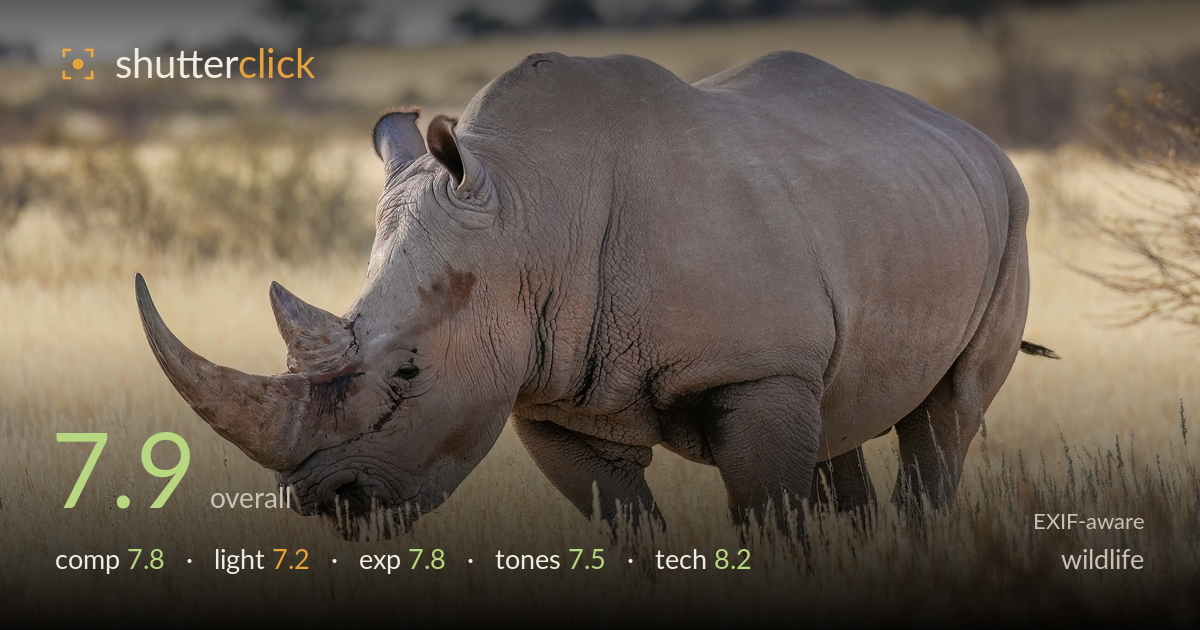
White rhino grazing on the savanna
Photo by Giles Laurent

| Focal length | 200 mm |
| Aperture | f / 2.8 |
| Shutter | 1/4000 s |
| ISO | ISO 400 |
| Exp. comp. | 0.0 EV |
| Shot at | 15:07 · Jul 22, 2025 |
A clean, full-body profile of a white rhino at eye level, sharp where it counts and set against a beautifully melted savanna background. The horn and the deeply textured skin carry real presence. What holds it back most is the light: flat, hazy, and slightly overhead, so the form reads a touch two-dimensional and the highlights on the back go pale. Head placement near the left edge crowds the horn against the frame's boundary, and the bright sky band at the top adds little. Strong wildlife work that a stronger hour of light and a touch more nose room would lift further.
The full profile with the head lowered into grazing posture is a natural, readable pose, and eye-level framing puts the viewer in the animal's world. The blurred grassland separates the subject cleanly. The weakness is nose room: the head and horn sit tight against the left edge, so the animal's implied forward movement runs into the frame boundary rather than into open space. A little more room ahead and slightly less weight behind would balance the gaze. The pale sky strip at the top contributes little tension.
The light is soft and largely diffuse — likely hazy or slightly overcast — which flattens the massive body and mutes the modelling that would otherwise reveal the rhino's bulk and skin folds. There is enough directionality to separate the near leg from the flank, but the highlights across the back and shoulder go a touch chalky without a strong shadow side to anchor them. Lower, warmer, more raking light in the golden hour would carve the texture of the hide and horn far more dramatically.
Exposure is well judged for the conditions. The grey hide holds detail across shoulder, flank and leg without blocking up in the deep skin creases, and the golden grass retains texture. The brightest patches on the back edge toward pale but do not clip meaningfully. The pale sky is the only near-blown region, and that is a minor upper band rather than a subject concern. Midtones sit comfortably, and the histogram appears to use its range sensibly. A deliberate, controlled exposure throughout.
The warm ochre grass against the cool grey rhino is a pleasing complementary pairing, and the palette feels true to a dry-season savanna. Contrast is a little low as a consequence of the flat light, leaving the overall image slightly soft in punch. White balance reads accurate and neutral on the hide. The horn and skin folds carry good subtle tonal gradation. A gentle contrast lift and a touch of clarity on the subject would give the tones more separation from the hazy backdrop.
The Sony A1 with the 70-200mm f/2.8 GM at 200mm is well suited to this reach, and the execution is sound. At 1/4000s the animal is frozen cleanly — arguably faster than needed for a grazing rhino, but harmless at ISO 400, which keeps noise essentially invisible. Focus is placed accurately on the near eye and the deeply textured skin of the head, the critical zone for wildlife. f/2.8 wide open delivers the shallow depth of field that dissolves the background into smooth wash, isolating the subject beautifully. The trade-off is that at this distance f/2.8 leaves the far flank and hindquarters marginally softer than the head, and stopping to f/4 or f/5.6 would have carried sharpness fully across the body while still holding background separation, at a modest ISO cost the A1 handles with ease. Overall a confident, well-controlled capture with focus, shutter and ISO all appropriate to the subject.
What would elevate it
Tags
Shot something like this?
Expert photo critique, on demand — scored across six categories, EXIF-aware. Start with 3 free critiques, no credit card.
critique my photo — free