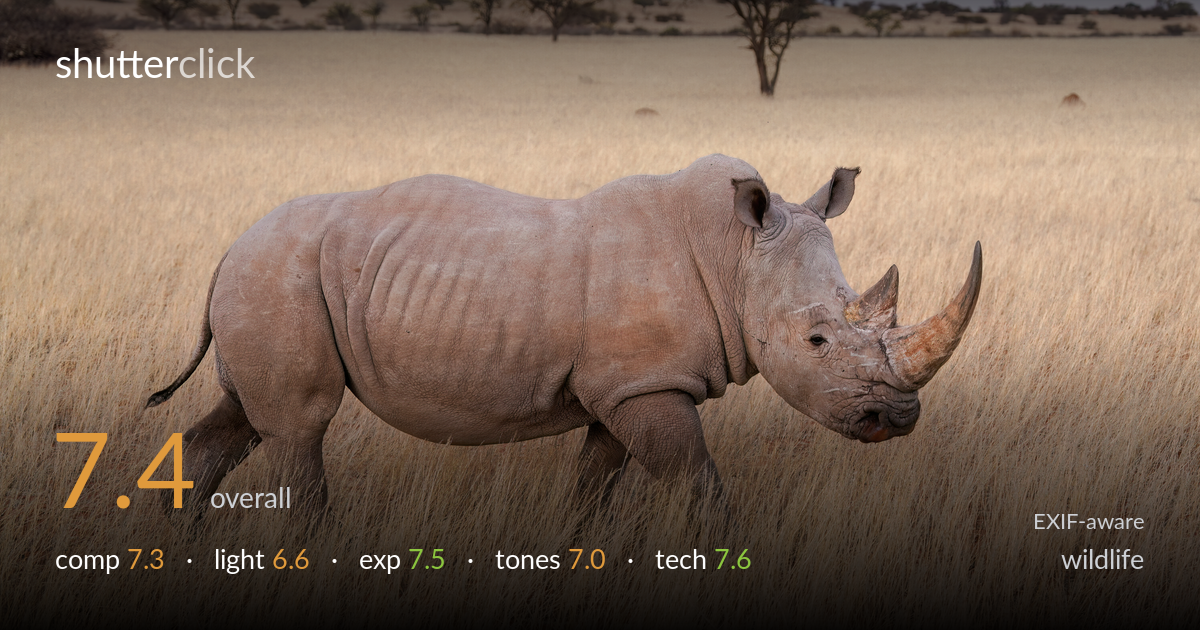
White rhino in the kalahari grass
Photo by Giles Laurent

| Focal length | 57 mm |
| Aperture | f / 2.8 |
| Shutter | 1/1600 s |
| ISO | ISO 200 |
| Exp. comp. | 0.0 EV |
| Shot at | 14:15 · Jul 21, 2025 |
A clean, well-executed environmental portrait of a white rhino in classic Kalahari grassland. The side-on profile shows off the animal's horn and bulk, and the broad context placement conveys habitat well. What most holds it back is the light: flat, slightly hazy overhead illumination gives the hide little dimension and mutes the scene. The horn faces directly out of frame with the rhino walking toward the edge, leaving negative space behind rather than in the direction of travel. A lower-angle, golden-hour approach and a reframe to lead the animal into the space would lift this from competent record shot to memorable image.
The profile orientation reads cleanly and the rhino sits low in the lower third, giving the savanna and that lone acacia room to breathe. The horizon placement at the upper third works well for scale. The main weakness is direction of movement: the animal walks toward the right edge with little space ahead of it, so the eye runs off the frame rather than into open landscape. The acacia and scattered bushes provide useful background interest without clutter, but balancing the rhino slightly left would give the gaze somewhere to go.
The light is the limiting factor here. It reads as high, near-overhead and slightly hazy, producing flat, low-contrast illumination across the hide. The rhino's folds and skin texture, which can be a striking feature, stay muted because there's no raking direction to carve them out. Shadows are soft and shallow, so the form lacks the modeling that low side light would deliver. The grass also goes uniformly bright without the warm glow of early or late sun. Workable, but undramatic.
Exposure is well judged. The pale hide holds detail without blowing out, and the bright dry grass stays under control despite its luminance. The sky is a touch washed but retains some cloud structure. Shadow areas under the belly and legs keep enough detail to read form. At ISO 200 there's clean tonal range throughout, and the histogram clearly sits in a comfortable place with no significant clipping. A deliberate, accurate rendering of a high-key scene.
The palette is honest to the Kalahari: warm straw grass against the cool grey hide makes for a pleasant natural separation. White balance looks accurate, neither too warm nor too cool. Contrast is on the gentle side, partly a product of the flat light, which leaves the overall image a little soft tonally. The sky drifts toward a slightly muddy lavender that doesn't add much. A subtle contrast lift and warming of the grass would give the tones more vitality.
Settings are well-matched to the subject. The 1/1600s shutter freezes the walking rhino cleanly with no motion blur, and ISO 200 keeps the file clean with ample latitude. The 57mm focal length on full frame gives a natural perspective that suits an environmental wildlife portrait, though it implies a fairly close working distance. The one debatable choice is f/2.8: wide open on a 24-70 the depth of field is shallow for an animal of this size at this distance, and while the eye and near flank look sharp, the far end of the body and the background fall off softly. For a profile this long, f/5.6 to f/8 would have carried sharpness across the whole animal while still throwing the distant acacia gently out of focus. Focus itself is accurately placed on the head and eye, which is the priority. Overall execution is solid and dependable; only the aperture decision leaves performance on the table.
What would elevate it
Tags
Shot something like this?
Expert photo critique, on demand — scored across six categories, EXIF-aware. Start with 3 free critiques, no credit card.
critique my photo — free