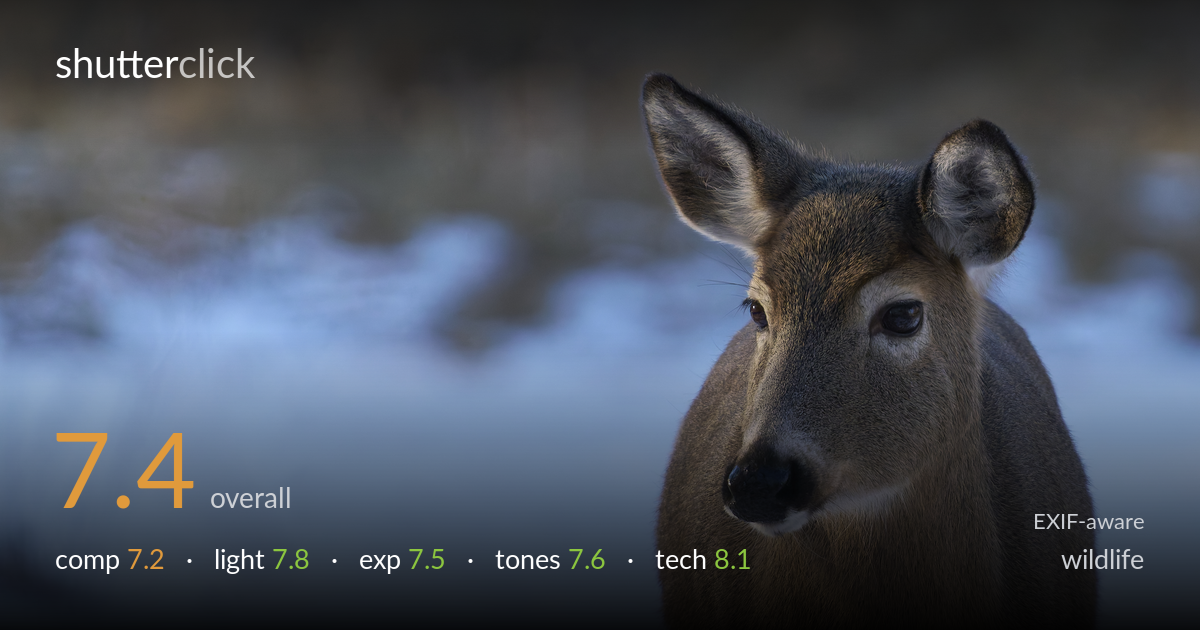
White-tailed deer in winter light
Photo by Paul Danese

| Focal length | 840 mm |
| Aperture | f / 9.0 |
| Shutter | 1/1250 s |
| ISO | ISO 2500 |
| Exp. comp. | 0.0 EV |
| Shot at | 16:06 · Jan 30, 2025 |
A clean, warmly lit white-tailed deer portrait that benefits from low-angle winter light and generous negative space. The animal sits to the right with the gaze leading back into the open frame, a classic and effective choice. What most holds it back is that the deer faces away from the camera at a three-quarter rear angle, so the connection feels slightly withheld, and the near eye sits a touch soft compared to the crisply rendered fur. The blue-toned snow against the warm coat reads pleasantly, though the background grass band competes for attention near the ears.
Placing the deer hard right with the snow expanse filling two-thirds of the frame gives the gaze room to travel, and the eye direction into the open space is well judged. The negative space carries mood without feeling empty. The rear three-quarter posture, however, leaves the body turned away, which weakens the sense of engagement. The blurred grass band crossing behind the ears adds slight visual clutter where a cleaner separation would isolate the head. The lower body crop is acceptable for a portrait-style wildlife frame.
Low, warm side light rakes across the face and chest, modeling the fur with gentle dimension and lifting the coat to a rich brown. The directional quality separates the muzzle and brow from shadow nicely. A small catchlight is present in the near eye, which helps it read. The cool blue snow behind plays off the warm subject for a pleasant temperature contrast. The far ear edge catches a bright rim that works. Slightly more frontal fill would have opened the shadowed left side of the face.
Exposure is handled well across a tricky bright-snow scene. The coat retains midtone detail without muddying, and the snow holds tone rather than blowing to pure white, preserving the subtle blue cast. Highlight detail in the white throat and ear interiors is intact. Shadow areas on the chest and lower neck stay readable. No exposure compensation was dialed, yet the metering held the snow well. A touch more shadow lift on the lower body would recover the darker fur without harming the balance.
The warm-cool split between the brown coat and blue snow is the image's strongest tonal asset, and it reads naturally rather than oversaturated. Skin and fur tones are believable, the black nose anchors the contrast, and the white throat patch provides a clean tonal accent. The blue cast on the snow is cool but not unpleasantly so for winter blue-hour light. Mid-tone gradation across the face is smooth. A marginally warmer white balance would keep the snow from tipping slightly toward heavy blue.
At 840mm with the 200-600mm and 1.4x teleconverter, reach and compression are used effectively to isolate the subject and render the smooth background. f/9 is a sensible choice at this focal length, giving enough depth to carry the muzzle-to-ear plane sharp while keeping the snow and grass dissolved. 1/1250s comfortably freezes a stationary deer with no motion blur. ISO 2500 is well controlled on the A7R5 sensor — noise is minimal and detail in the fur is excellent. The one weakness is focus placement: the sharpest plane sits on the brow and fur rather than precisely on the near eye, which appears marginally soft. For a wildlife portrait the eye is the critical plane, so eye-AF lock or a focus point nudged onto the eye would have sealed it. Overall a technically assured capture with strong gear discipline.
What would elevate it
Tags
Shot something like this?
Expert photo critique, on demand — scored across six categories, EXIF-aware. Start with 3 free critiques, no credit card.
critique my photo — free