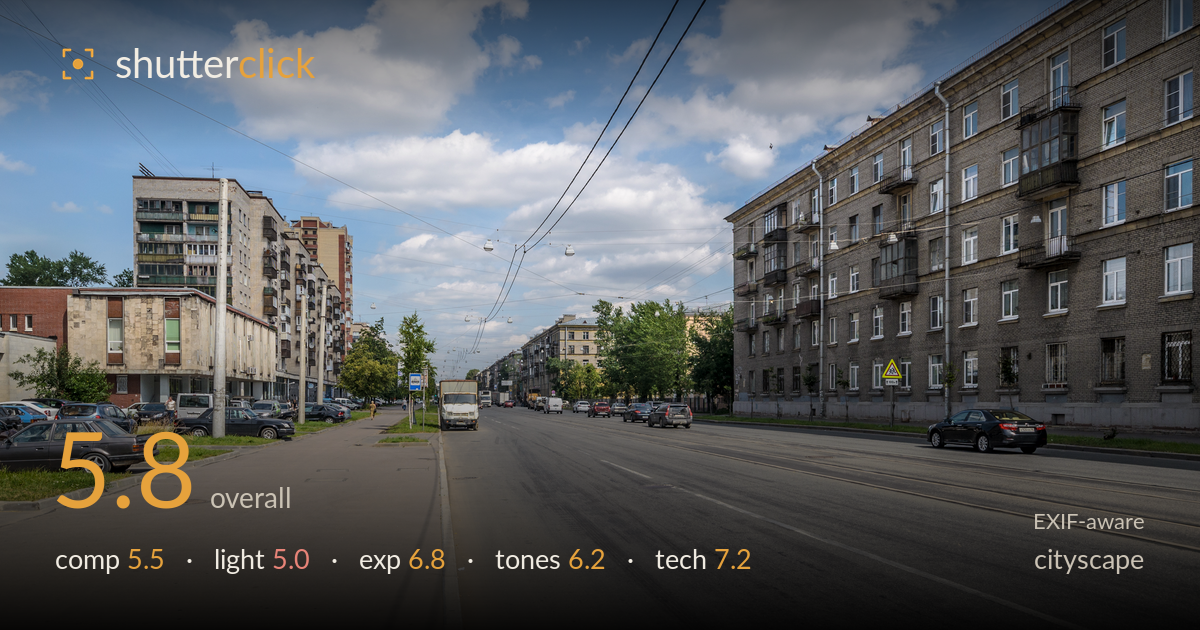
Wide avenue under summer sky
Photo by Florstein (Telegram:WikiPhoto.Space)

| Focal length | 16 mm |
| Aperture | f / 7.1 |
| Shutter | 1/500 s |
| ISO | ISO 100 |
| Exp. comp. | -0.67 EV |
| Shot at | 13:58 · Jul 15, 2014 |
A clean, documentary record of a St. Petersburg avenue that reads as straightforward street topography rather than an intentional cityscape. The wide receding road pulls the eye toward a vanishing point, but the frame is dominated by a large empty road and a huge swathe of sky, leaving no clear subject to anchor attention. Midday sun flattens the brick facade and washes the scene of atmosphere. The verticals are well controlled for a 16mm ultrawide, and exposure is sensibly protected. What holds it back most is the absence of a decisive light or moment — it documents the place without giving a reason to linger.
The receding road on the right and the long apartment block create a natural perspective line toward the vanishing point, which is the frame's strongest structural idea. But the composition is split between two competing halves with a broad, empty road and a large expanse of unremarkable sky consuming the upper half. No single element commands attention. The overhead cables slice awkwardly across the sky. Bringing the horizon lower or higher, and choosing one side to dominate, would give the frame a clearer subject and more intention.
Hard, near-overhead midday sun is the main limitation. It flattens the brick facade of the apartment block, mutes the modelling on the buildings, and produces short, uninformative shadows across the road. The sky has attractive cumulus cloud detail, but the ground plane lacks the directional light that would give texture and depth. Early or late golden-hour light raking down the length of the avenue would reveal facade relief and lengthen shadows into leading lines, transforming a flat record into a shaped scene.
Exposure is handled well. The -0.67 EV compensation protects the bright cumulus highlights, keeping cloud detail intact while the shadowed side of the left buildings retains information. The road and facade midtones sit at a sensible brightness with no meaningful clipping. The dynamic range of a bright sky over shadowed streets is well managed here. If anything, the darker facade recesses on the left buildings sit slightly heavy, but nothing is lost — this is a deliberate, competent exposure judgement.
White balance is neutral and believable, with the blue sky reading naturally and the warm brick facade rendered honestly. Contrast is moderate and appropriate for the flat light, though the overall palette is muted — grey road, grey-brown buildings, and washed blue sky. There's little colour tension to hold interest. The greens of the roadside trees provide the only saturated relief. A touch more contrast separation between sky and buildings, and slightly richer greens, would lift the tonal interest without looking artificial.
The technical execution is sound and well matched to the scene. At 16mm on the ultrawide zoom, f/7.1 delivers front-to-back sharpness suited to a deep cityscape, and it sits comfortably in the lens's sweet spot, avoiding both wide-open softness and diffraction. ISO 100 keeps the image clean with no visible noise, and 1/500s easily freezes the moving traffic — arguably faster than needed for a static-intent frame, though it costs nothing here. Focus is accurate across the depth of field. The main technical concern is perspective control: the ultrawide handles the verticals of the right-hand block reasonably well, with only slight convergence, but the extreme angle of view exaggerates the empty foreground road and stretches the composition. Stopping down further would not help; a slightly longer focal length or a step back with a more considered framing would use the same clean settings to better compositional effect. Overall a technically reliable capture with no execution errors.
What would elevate it
Tags
Shot something like this?
Expert photo critique, on demand — scored across six categories, EXIF-aware. Start with 3 free critiques, no credit card.
critique my photo — free