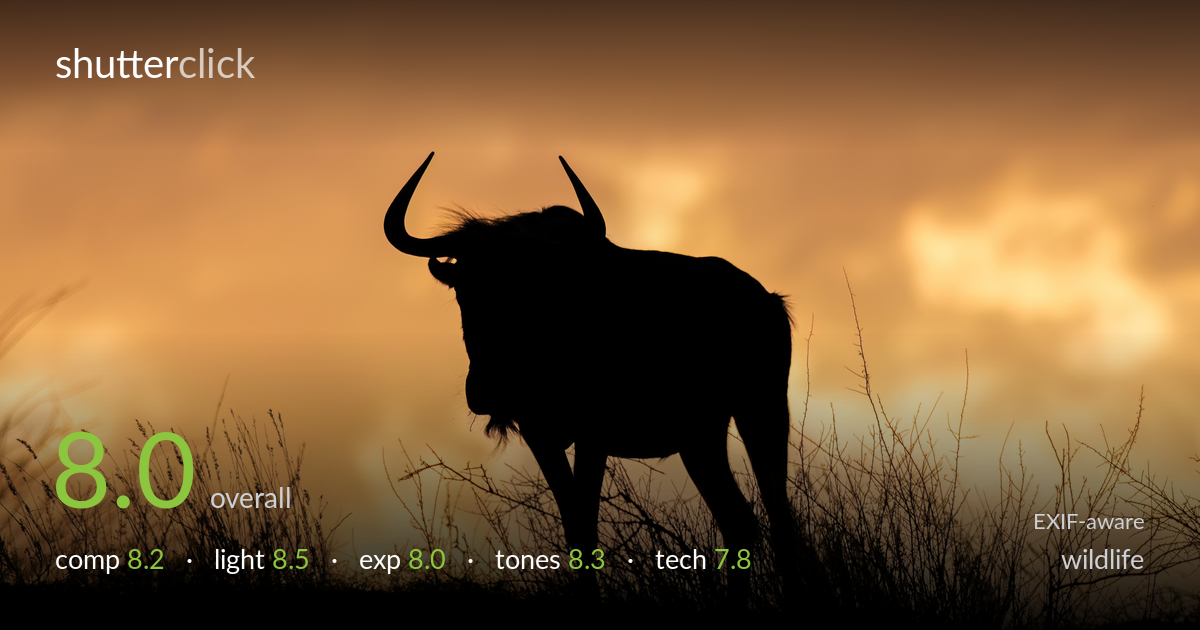
Wildebeest at sunset
Photo by Giles Laurent

| Focal length | 572 mm |
| Aperture | f / 7.1 |
| Shutter | 1/400 s |
| ISO | ISO 250 |
| Exp. comp. | 0.0 EV |
| Shot at | 16:01 · Jul 22, 2025 |
A clean, well-executed silhouette that leans entirely on shape and light, and largely earns it. The wildebeest's profile reads instantly — the distinctive horns, beard, and stance are unmistakable against a glowing sky. The animal's placement, weighted right of centre with the head turned toward the camera, gives the frame direction and tension. Backlit grasses add a delicate, textural foreground that grounds the subject. The chief limitation is the genre convention itself: a silhouette sacrifices the sharp, lit eye that defines strong wildlife work, so the image succeeds as a graphic study rather than an intimate animal portrait. The lower foreground also reads as a heavy, featureless black band.
The wildebeest sits cleanly in the right two-thirds, its turned head reaching back toward the lighter sky and creating a satisfying directional pull. The horns break the upper negative space without crowding the frame edge, and the backlit grasses build a layered foreground that anchors the subject on the ridge. The placement reads deliberate. The lower third collapses into a near-featureless black band that carries little information and weights the bottom heavily. A slightly higher horizon or a touch more sky above the horns would relieve that imbalance and give the silhouette more breathing room overhead.
The timing is the strongest decision here. Shooting straight into a low sun renders the animal as pure shape while the broken cloud catches warm light, producing a layered orange backdrop with real tonal variation rather than a flat wash. The rim glow threading through the grass stems is a lovely detail and proves the light direction was used intentionally. The brightest cloud mass sits behind and above the subject, which separates the form cleanly. A marginally lower sun angle might have added a thin rim highlight along the animal's back to lift it further from the sky.
Exposure is judged well for a deliberate silhouette. The sky retains gradation from deep amber up top to a brighter band at the horizon, with no obvious blown highlights even in the lit cloud — impressive given the bright source. The subject falls to clean black, which is the intended outcome, and the grasses keep just enough rim detail to read. The only cost is the foreground, which loses all separation below the ridge. Lifting the deepest shadows a touch in post would recover a hint of ground texture without compromising the silhouette.
The warm palette is the image's emotional engine — amber and gold gradients move smoothly across the sky without banding, and the white balance leans warm in a way that suits sunset wildlife. Contrast between the black subject and luminous background is high but controlled, never harsh. The transition from bright horizon to deeper sky overhead is handled gracefully. Saturation sits just shy of garish, which is the right call. If anything, a fractional pull-back on the orange could prevent the brightest cloud from edging toward over-saturation, but the grade is largely convincing.
The 572mm reach on the FE 400-800mm compresses the scene effectively, flattening the cloud layers behind the animal and lending the silhouette a clean, isolated presence. At f/7.1 the depth of field renders the subject and foreground grasses crisply while the cloud detail softens pleasantly — an appropriate aperture for the distance. ISO 250 keeps noise invisible across the smooth sky, where any grain would show first, and the shutter at 1/400s comfortably freezes a stationary, alert animal. Focus appears to sit on the body and head, which is correct for a backlit subject where eye detail is unrecoverable anyway. The settings are well matched to the conditions. The one caution is the modest shutter for a long lens handheld at this focal length — 1/400s leaves little margin if the animal had moved or if there was camera shake, though the result here looks clean. A faster shutter would build in safety without meaningfully raising ISO given the bright backdrop.
What would elevate it
Tags
Shot something like this?
Expert photo critique, on demand — scored across six categories, EXIF-aware. Start with 3 free critiques, no credit card.
critique my photo — free