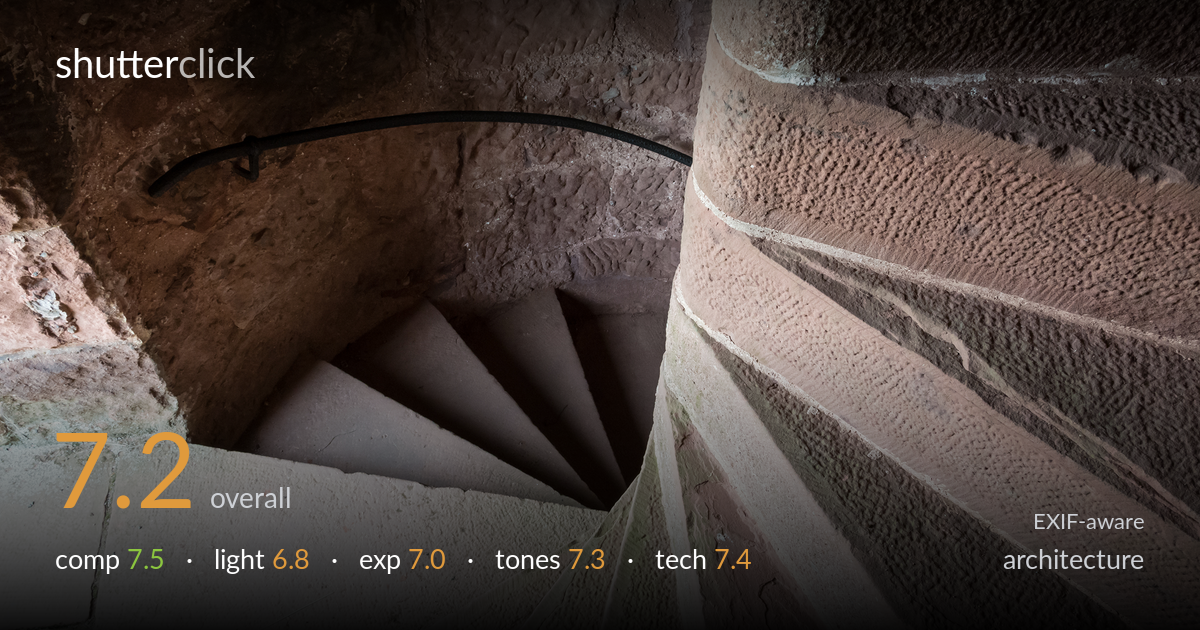
Winding sandstone stairwell
Photo by Jacek Halicki

| Focal length | 18 mm |
| Aperture | f / 11.0 |
| Shutter | 1/30 s |
| ISO | ISO 1800 |
| Exp. comp. | 0.0 EV |
| Shot at | 10:31 · Jun 2, 2016 |
The spiralling sandstone staircase is the clear strength here — the radiating wedge-shaped treads sweep through the frame and create genuine rotational energy, drawing the eye down and around the central newel post. The worn stone texture is well rendered and the warm reddish palette suits the medieval interior. What most holds the image back is the lighting: flat, diffuse window light leaves the upper-left wall murky and underlit, and the central well of the stair falls into shadow without enough detail to read as deliberate. A touch more separation between treads and a cleaner read of the dark recess would lift it from a strong record shot toward something more dimensional.
The radiating treads form a powerful spiral that pulls the eye down and around the central column — a natural fit for the subject and the strongest element here. The diagonal of the curving handrail in the upper portion adds a secondary line that balances the heavy stone mass on the right. The dark recess at left, however, holds little detail and reads as dead weight rather than considered negative space. Framing the descending well slightly more centrally, or lower, would let the spiral resolve more completely instead of running out of frame.
The light is soft and directional, entering from upper right and grazing the sandstone enough to bring out its pitted texture on the right-hand wall and treads — that raking quality is the most successful lighting choice. Elsewhere it works against the image: the upper-left wall sits in muddy, flat shadow, and the central stair well falls dark without enough modelling to feel intentional. A stronger single source, or shooting when window light reached deeper into the well, would have carved the descending steps with more dimension and depth.
Exposure is broadly well judged for a difficult mixed-light interior. The textured treads on the right retain full detail and the brighter stone at lower left holds without clipping. The shadowed recess at upper left and the central well, though, sink into near-featureless dark — likely a dynamic-range limit rather than a clean decision. A half-stop more in those areas, or shadow recovery in post, would preserve the architectural form in the well. Overall the midtones are placed sensibly and highlights are controlled.
The warm reddish-brown sandstone palette is rendered convincingly and reads true to the material — a coherent, earthy range that suits the medieval setting. The greenish algae staining on the lower treads adds a believable note of age. Contrast is on the gentle side, which keeps texture readable but lets the darker passages turn muddy rather than richly black. White balance leans warm but appropriately so. A slightly deeper black point would add punch without sacrificing the stone's tactile mid-tones.
At 18mm and f/11 the depth of field comfortably covers the near and far treads, an appropriate choice for an architectural interior where front-to-back sharpness matters. Focus appears accurate across the stone surfaces and the texture is crisp where light reaches it. The 1/30s shutter is fine for a static handheld subject, though it pushed ISO to 1800 — a touch of luminance noise is visible in the darker passages but it is well controlled for this sensor. The 18mm wide angle introduces some perspective stretch, exaggerating the foreground treads, which actually serves the spiral dynamic here rather than hurting it. A tripod would have allowed a lower ISO and a cleaner shadow rendering, and bracketing for an HDR blend would have tamed the wide tonal gap between the lit treads and the dark well. Overall the execution is solid and the settings are sensibly matched to the subject.
What would elevate it
Tags
Shot something like this?
Expert photo critique, on demand — scored across six categories, EXIF-aware. Start with 3 free critiques, no credit card.
critique my photo — free