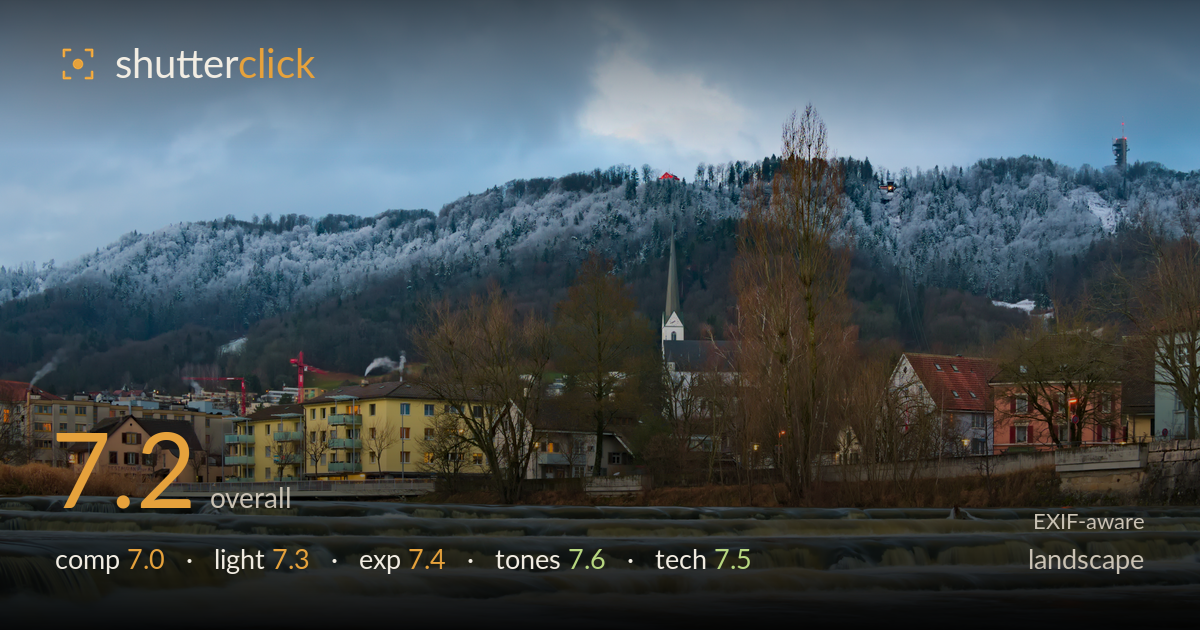
Winter dusk over the weir
Photo by Daniel Kraft

| Shot at | 07:42 · Feb 5, 2020 |
A well-layered winter riverscape that reads clearly from foreground stones to the frost-dusted ridge behind. The three-band structure — pebble bank, stepped weir, town and forested hill — gives real depth, and the blue-hour palette holds together nicely with the warm interior lights as accents. What most holds it back is the foreground: the pebble bank enters awkwardly from the lower-left corner and the smoothed water sits somewhat flat and grey in its lower reaches. The church spire is a strong anchor but competes with a slightly busy middle band. A cleaner foreground and a touch more separation between the town and hill would sharpen an already accomplished scene.
The horizontal layering works: pebble bank, cascading weir, town strip, and snow-frosted ridge stack into clear depth. The church spire provides a natural focal anchor slightly right of centre, and the weir's stepped diagonals lead the eye across the frame. The pebble bank, however, intrudes from the lower-left corner as an unresolved wedge rather than a deliberate foreground element. The town band is a little cluttered and jostles for attention. A foreground element placed more centrally, or a lower angle emphasising the water's flow lines, would tie the layers together.
Blue-hour light suits the subject, rendering the frosted forest and overcast sky in cool, even tones while the warm window and street lights punctuate the scene with welcome contrast. The flat, diffuse overcast keeps the snow detail intact on the hillside without harsh shadows. The tradeoff is a lack of modelling — the light is soft to the point of being featureless across the water and mid-town band. A slightly earlier moment with a touch more western glow, or catching the lights a stop brighter against a darker sky, would add drama.
Exposure is well judged for the dim conditions. Highlights in the sky and the white weir foam hold detail without clipping, and shadow areas in the forest retain texture rather than blocking up. The warm interior lights are exposed to glow rather than blow out, which is a careful balance at this hour. The lower foreground water drifts slightly muddy and flat, and the overall image sits a touch dark in the midtones — a modest lift there would open the town band without sacrificing the moody sky.
The cool blue-hour grade is cohesive and atmospheric, with the frosted ridge, grey sky, and smoothed water sharing a consistent temperature. The warm yellows of the buildings and the amber window lights provide effective complementary accents against that coolness. White balance reads accurate for dusk. Contrast is a little soft in the water and lower foreground, leaving them muddy, and saturation is restrained appropriately for the mood. A gentle contrast lift in the midtones and slightly cleaner separation between the town greens and hill would refine the tonal range.
The long exposure on the weir is the technical centrepiece and it is executed cleanly — the cascading steps show that soft, milky flow without going fully featureless, retaining enough structure to read as moving water. Sharpness across the town and the frosted ridge is good, indicating a stable tripod and a well-chosen aperture for front-to-back depth of field. Focus appears accurate on the mid-ground town, and the frost detail on the distant trees holds up, suggesting a decent lens and careful capture. Noise is well controlled for the low light. The main technical weakness is the lower foreground water, which loses definition and drifts flat — likely the exposure ran long enough to smooth it past the point of interest. A slightly shorter exposure, or a foreground rock breaking the surface, would preserve more texture there. The pebble bank is sharp but the frame edge crops it awkwardly. Overall a technically assured capture of a difficult light situation.
What would elevate it
Tags
Shot something like this?
Expert photo critique, on demand — scored across six categories, EXIF-aware. Start with 3 free critiques, no credit card.
critique my photo — free