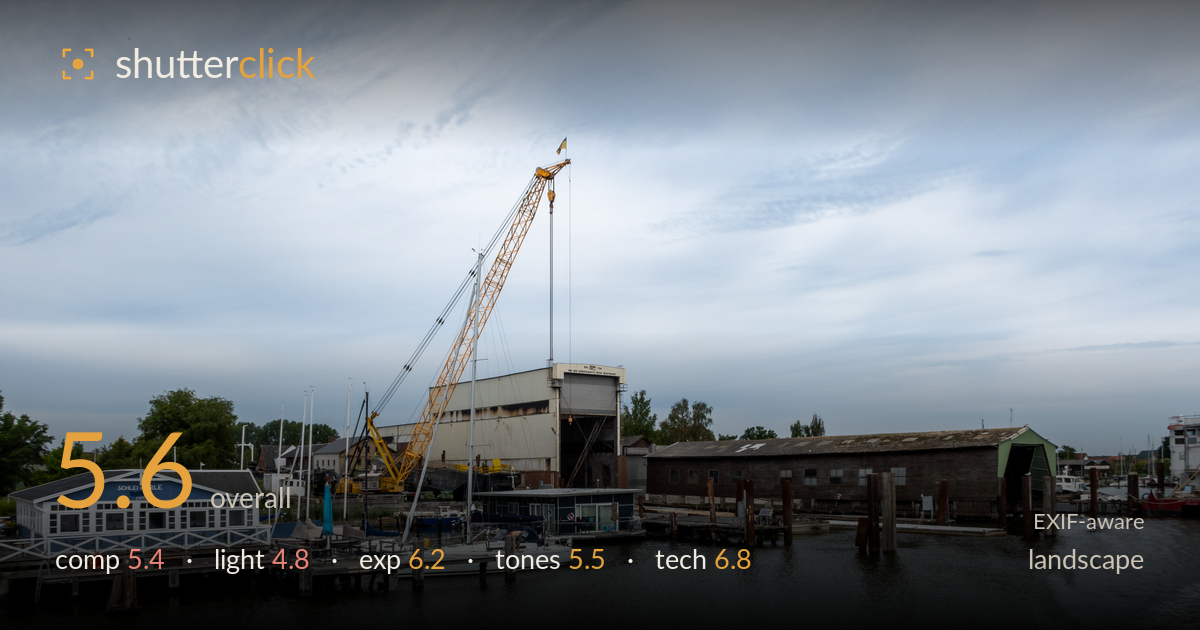
Working shipyard on an overcast day
Photo by Dietmar Rabich

| Focal length | 9 mm |
| Aperture | f / 9.0 |
| Shutter | 1/500 s |
| ISO | ISO 125 |
| Exp. comp. | 0.0 EV |
| Shot at | 11:03 · Jun 20, 2023 |
This is a competent working-harbour documentation, but it reads as record-keeping more than a composed landscape. The yellow crane is the natural focal point and anchors the frame's left half well, yet the right two-thirds drift into repetitive sheds, pilings and a flat, featureless sky that fills nearly half the frame without earning it. The overcast light is honest but inert, giving the whole scene a low-energy, slightly muddy feel. The core problem is that the strongest element and the emptiest space are unevenly balanced, and the flat light offers nothing to shape the many textural subjects a shipyard could provide.
The crane provides a strong vertical accent and its diagonal boom leads the eye across the left of the frame, which is the picture's best structural idea. But the right half loses discipline — a long, low run of sheds and a fence of pilings repeat without a resolving element, and the sky occupies close to half the frame with little cloud interest to justify it. The horizon sits a touch high on the right. A tighter framing on the crane, boats and blue café would concentrate the interest.
Flat overcast light dominates, and here it works against the scene. A busy shipyard rewards raking or directional light that separates the crane's lattice, the weathered sheds and the piling textures; instead everything sits under the same soft, shadowless wash, flattening depth and muting the subjects into one another. The sky reads as a bright, near-featureless field rather than a mood-setting element. Shooting toward golden hour, or on a day with more defined cloud structure, would give the metal and timber the modelling they need.
Exposure is well handled for the conditions. The bright overcast sky is held without significant clipping, and the darker sheds and the boat interiors retain usable shadow detail, so the dynamic range is managed cleanly. Midtones sit a little low across the harbour water and timber, contributing to the slightly heavy feel, but nothing is lost at either end. The exposure decisions read as deliberate and safe. A small positive exposure compensation could have lifted the water and buildings a touch without endangering the sky.
The palette is muted and cool, which suits an overcast Baltic harbour but here tips toward drab. The water is a flat grey-green with little tonal separation from the sheds behind it, and the overall contrast is low, leaving the image lacking punch. The yellow crane and the blue café are the only chromatic lifts and they carry the frame. White balance is neutral and believable. A modest contrast and clarity boost, plus slightly warmed midtones, would give the timber and water more presence.
The settings are sensible for a wide grab shot of a static scene. At 9mm and f/9 on a 1-inch sensor, depth of field is effectively total, so foreground pilings and the distant sheds are all rendered sharp — appropriate for a landscape where everything should hold. ISO 125 keeps noise negligible and tonal quality clean, and 1/500s is far faster than needed here, which suggests the shutter defaulted high rather than being chosen; a slower speed would have permitted a lower ISO still, though at base ISO this is moot. Focus is accurate across the plane and there is no visible motion blur. The main technical limitation is the lens's wide end pushing peripheral elements small and slightly soft at the edges, and the flat f/9 rendering giving no subject separation — though separation was never the goal in a documentary landscape like this. Overall execution is solid and unremarkable; the settings do the job without adding anything.
What would elevate it
Tags
Shot something like this?
Expert photo critique, on demand — scored across six categories, EXIF-aware. Start with 3 free critiques, no credit card.
critique my photo — free