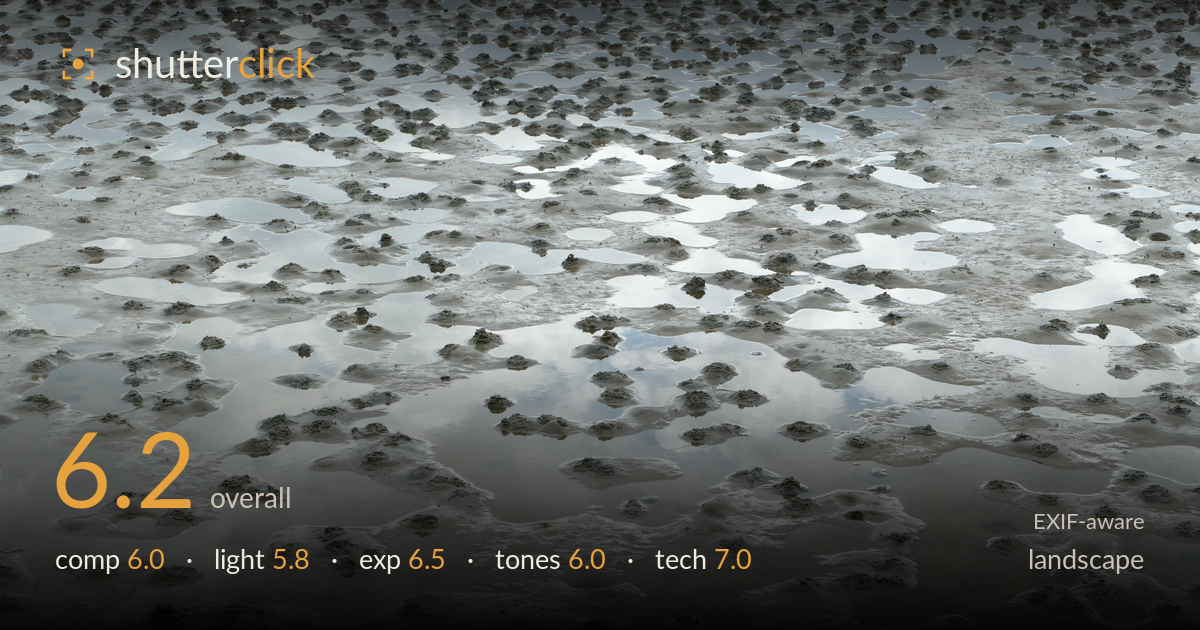
Worm casts on the mudflats
Photo by W.carter

| Focal length | 25 mm |
| Aperture | f / 8.0 |
| Shutter | 1/320 s |
| ISO | ISO 125 |
| Exp. comp. | 0.0 EV |
| Shot at | 12:05 · May 7, 2017 |
This mudflat study reads more as texture-and-pattern abstraction than conventional landscape, and its strongest quality is the receding rhythm of worm casts and reflective pools that pulls the eye toward the horizonless top edge. What most holds it back is the lack of an anchor: the frame is uniformly busy from corner to corner, giving the eye nowhere to rest and no sense of scale. The flat overcast light keeps the casts under-modelled, and the near-monochrome grey palette, while atmospheric, drifts toward muddy. A single focal element or a stronger foreground would elevate the pattern into a picture.
The frame is filled edge to edge with a repeating field of mud casts and mirror-bright puddles, and the diminishing scale toward the top does create genuine depth. But the composition offers no anchor or resting point — every region carries equal visual weight, so the eye wanders without landing. There's no foreground hero, no horizon, no scale cue. A slightly lower angle catching a single prominent cast in the near foreground, or including a sliver of sky, would give the pattern a subject and turn even coverage into deliberate structure.
Flat, diffuse overcast light dominates, which suits wet-mud reflection by keeping the puddles clean and specular-free, but it leaves the raised casts poorly modelled. Without directional light there's little shadow to carve out their three-dimensional form, so texture that could have been the whole point reads softer than it should. Raking low side light — early or late in the day — would rim each mound and separate it from the water, dramatically increasing the sense of relief and turning the flat field into a landscape of tiny sculptural forms.
Exposure is handled well for a high-contrast reflective scene. The bright sky-reflecting puddles hold detail rather than blowing to paper white, and the darker mud retains structure, so the dynamic range is used sensibly across the frame. A few of the brightest reflections near the centre are close to clipping but stay recoverable. Neutral exposure compensation was the right call here. The midtones sit slightly grey and could take a modest lift in the darkest casts to open shadow detail without sacrificing the highlight retention.
The palette is a near-monochrome range of cool greys with faint warm sand tones creeping into the lower foreground. It's atmospheric and appropriate to the subject, but the overall tonality drifts muddy and flat, with midtones bunched and little separation between wet mud and dry. A touch more contrast, or a deliberate split toning that cools the reflections while warming the sand, would give the image more tonal shape. As it stands the grade feels neutral-to-untouched rather than a considered interpretation of the scene.
The settings are well chosen for this flat-field subject. At 25mm and f/8 the depth of field comfortably covers the receding plane, keeping detail sharp from near foreground to the distant casts — exactly right for a scene that relies on resolving fine texture across depth. ISO 125 keeps noise negligible and preserves the subtle tonal gradations in the puddles, and 1/320s handily eliminates any handheld shake at this focal length. Focus appears accurately placed in the mid-ground where the pattern is densest. The FZ1000's one-inch sensor holds up well here given the even, moderate contrast. The only technical reservation is that f/8 on this sensor is near the onset of diffraction softening; f/5.6 would have given marginally crisper cast detail while still holding the whole plane sharp at this distance. Overall this is clean, competent capture — the technical execution is not what limits the image; the lighting and compositional choices are.
What would elevate it
Tags
Shot something like this?
Expert photo critique, on demand — scored across six categories, EXIF-aware. Start with 3 free critiques, no credit card.
critique my photo — free