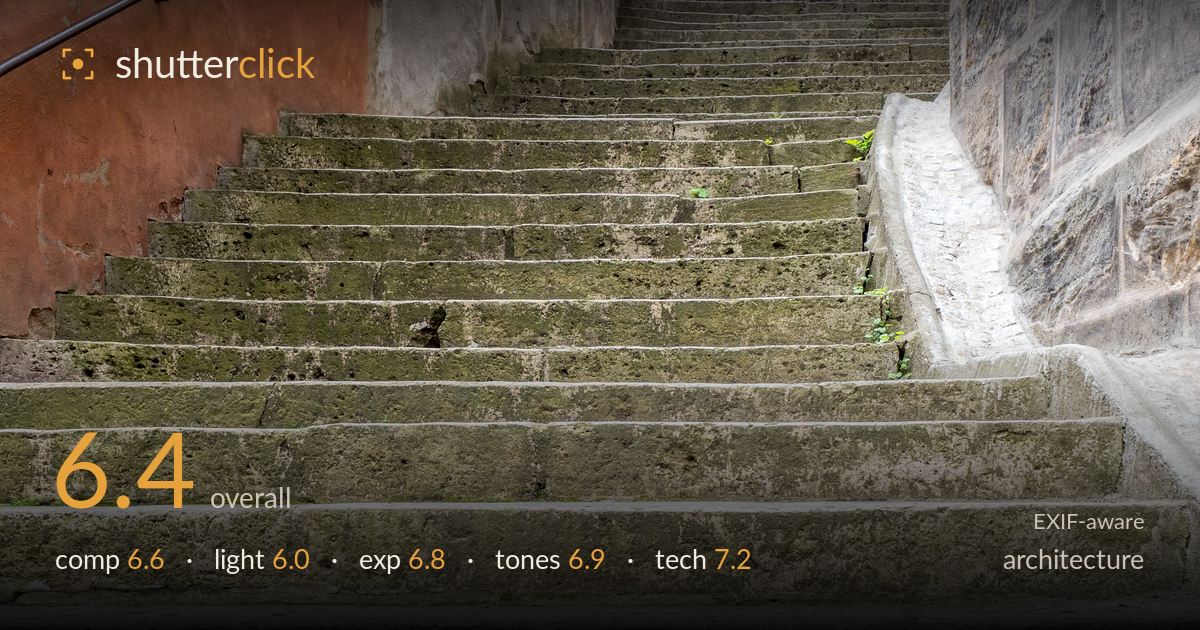
Worn stone steps climbing an old alley
Photo by Ermell

| Focal length | 18 mm |
| Aperture | f / 6.3 |
| Shutter | 1/80 s |
| ISO | ISO 200 |
| Exp. comp. | 0.0 EV |
| Shot at | 11:05 · Jul 1, 2017 |
A worn stone staircase climbing between contrasting walls carries genuine texture and a strong sense of place. The receding steps form a natural leading structure upward, and the interplay of warm rendered plaster on the left against cool grey masonry on the right gives the frame colour tension. What most holds it back is the flat, overcast light that keeps the stone surfaces reading as one soft tonal block, and the wide-to-narrow perspective distortion where the lowest step dominates while the upper flight compresses to nothing. A stronger sense of destination at the top would give the climb more purpose.
The staircase reads as a natural leading line drawing the eye upward toward the sandstone wall and lantern, and the warm-versus-cool wall split adds structure. The trouble is the enormous foreground step eating the bottom third while the upper flight compresses into a thin band — the weighting is bottom-heavy. The lantern and greenery at the top offer a modest focal reward but sit small and off to one side. A slightly higher shooting position, or stepping back, would balance the tread depths and give the top of the frame more presence.
Flat, diffuse overcast light dominates, which keeps the moss and pitted stone texture legible but robs the treads of the raking shadow that would reveal their relief. The stone surfaces flatten into a single soft mass with little modelling. There is a faint warmth on the upper sandstone that hints at what directional light could do here. Early or late side light skimming across the steps would carve each tread and lend depth to what is currently an even, low-contrast rendering across the whole staircase.
Exposure is well controlled for the conditions. Highlights on the pale upper sandstone hold detail without clipping, and the shadowed grey masonry on the right retains information rather than blocking up. The midtones sit comfortably, giving the worn stone its full range of surface variation. Nothing looks accidental — the overcast light made this an easy exposure to nail and it was handled cleanly. The only lift available is a touch more local contrast in the treads, though that is a tonal choice rather than an exposure fault.
The colour palette works in its favour: terracotta plaster left, cool grey stone right, and greenish moss threading through the treads create a muted but coherent scheme. White balance looks neutral and believable. Contrast is on the low side, appropriate to the flat light but leaving the image feeling slightly soft overall. The green moss saturation is handled with restraint rather than pushed. A modest contrast boost and a hint more separation between the warm and cool zones would give the tones more punch without breaking the natural feel.
At 18mm on Micro Four Thirds (36mm equivalent), f/6.3 delivers front-to-back sharpness that suits an architectural study, keeping both the near tread and the distant sandstone acceptably crisp. ISO 200 is ideal, yielding clean files with no meaningful noise. 1/80s handheld is fine for a static subject at this focal length with in-body stabilisation, and the image shows no motion blur. Focus sits appropriately mid-frame. The main technical limitation is not the settings but perspective: the moderately wide focal length exaggerates the nearest step and compresses the upper flight, and there is slight keystoning as the walls lean. Verticals on the right masonry drift inward. For architecture, a longer focal length from further back would compress the staircase more naturally and tame the near-far size disparity, or careful perspective correction in post would straighten the converging walls. Overall the execution is technically sound and the gear was used well within its strengths.
What would elevate it
Tags
Shot something like this?
Expert photo critique, on demand — scored across six categories, EXIF-aware. Start with 3 free critiques, no credit card.
critique my photo — free