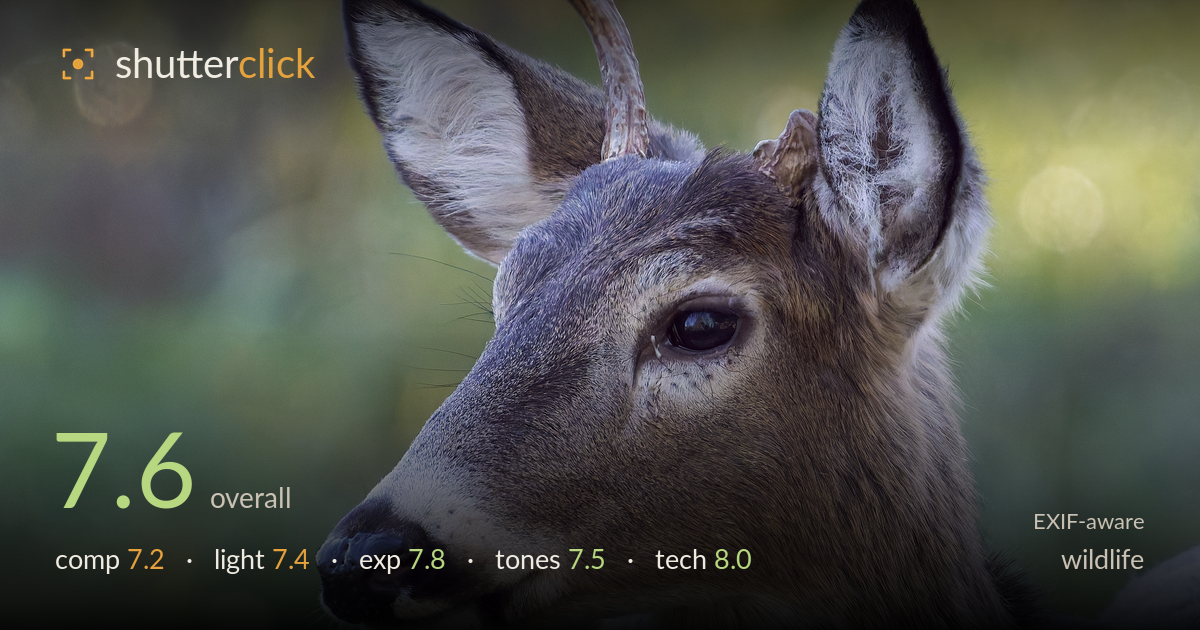
Young buck with a single antler
Photo by Paul Danese

| Focal length | 840 mm |
| Aperture | f / 9.0 |
| Shutter | 1/1250 s |
| ISO | ISO 10000 |
| Exp. comp. | 0.0 EV |
| Shot at | 14:57 · Nov 25, 2024 |
A clean, intimate portrait of a young white-tailed buck with a single spike antler, carried by a sharp eye and a smoothly rendered background. The head fills the frame with good presence and the fine detail across the face and whiskers holds up well. What holds it back most is the placement: the muzzle crowds the left edge, leaving little breathing room in the direction the animal faces, while empty space piles up behind. The single antler and torn ear read as character rather than flaw. Tightening the framing decision and pushing color separation would lift this from strong to standout.
The tight head-and-shoulders framing gives the buck real presence, and the diagonal set of the head adds energy. The problem is nose room: the muzzle nearly touches the left edge while the animal looks left, so the gaze runs into the frame boundary and the negative space collects uselessly behind the head. Shifting the subject rightward would give the look somewhere to travel. The antler reaching into the top-left is a nice compositional anchor. The lower body edge sits a little awkwardly, but the overall balance works.
Soft, diffused light — likely overcast or open shade — wraps the face evenly and avoids harsh shadows, which flatters the fur texture and keeps the dark eye from blocking up. A faint catchlight sits in the eye, though it's weak and could be stronger. The direction is gentle and slightly frontal, revealing the whiskers and the fine hairs along the muzzle. Nothing dramatic here, but the quality suits a calm portrait. A touch of directional light would add more modeling to the face and antler.
Exposure is well judged for a dark-eyed subject in muted light. The dark nose and eye retain detail without crushing, and the pale fur inside the ears and around the throat holds highlight information rather than clipping. Midtones on the brown coat sit comfortably. Given ISO 10000, the shadows stay clean enough, and no obvious blown areas appear in the background bokeh. The overall brightness reads deliberate and balanced, with headroom preserved across the range. A slight lift in the eye socket would add sparkle without risking the highlights.
The warm brown coat separates reasonably from the green-gold background, but the overall palette leans muted and slightly muddy in the mid-greens behind. White balance sits on the cool-neutral side, which keeps the fur honest but leaves the scene a bit flat. The subtle gradation across the face — from grey muzzle to warmer brown — is rendered nicely. Background greens and yellows blend without strong contrast, so the subject doesn't pop as much as it could. A modest boost in color separation and warmth would strengthen the mood.
At 840mm with the 1.4x teleconverter on the 200-600, this is a demanding setup handled well. Focus lands cleanly on the near eye, which is exactly where it belongs, and the whisker detail and fur texture confirm accurate acquisition. The 1/1250s shutter freezes the head completely, sensible insurance against sudden movement, though the calm pose could have tolerated slower. That would have mattered because ISO 10000 is the real cost here: noise is visible in the shadow areas and smooth background, and while the A7RM5's files clean up reasonably, a stop or two lower would have preserved more micro-detail in the fur. f/9 is slightly stopped down for this reach — f/8 or wider would have bought shutter or ISO headroom while keeping the eye sharp, since depth of field at this focal length is already thin. The G lens plus TC combination holds up admirably in sharpness. Focus, shutter, and lens choice are all sound; only the ISO ceiling limits the file.
What would elevate it
Tags
Shot something like this?
Expert photo critique, on demand — scored across six categories, EXIF-aware. Start with 3 free critiques, no credit card.
critique my photo — free