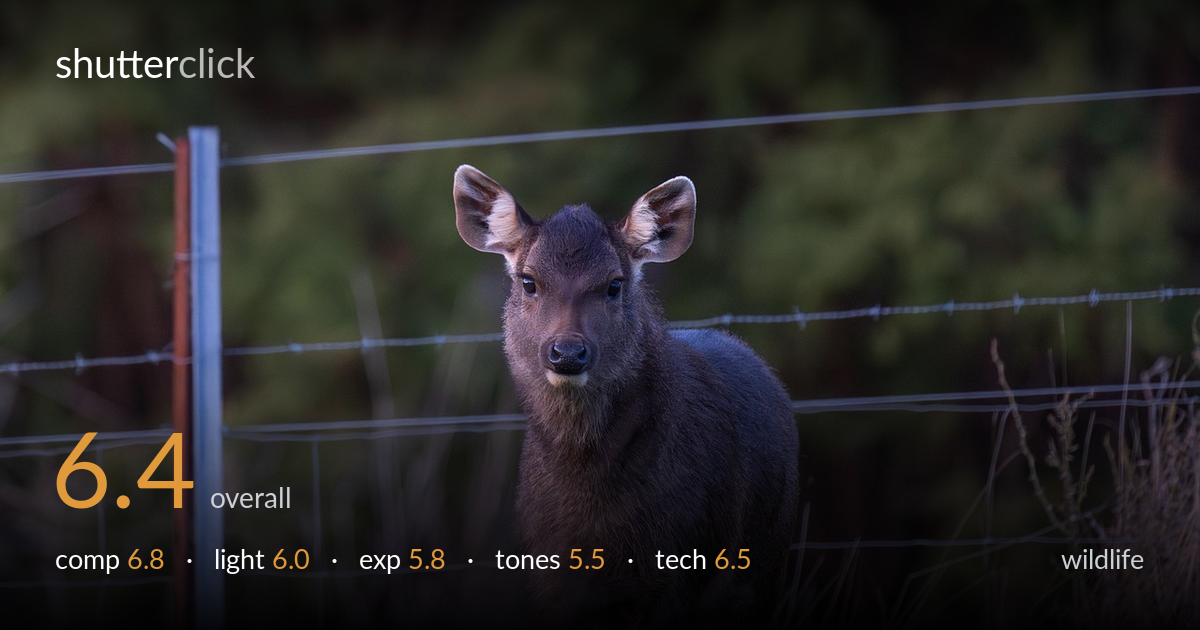
Young deer at the fence line
Photo by pen_ash

No EXIF metadata in this file
Technical analysis based on visual assessment only.
Direct eye contact and an alert, square-on stance give this deer portrait genuine presence, and the animal's placement in the frame holds attention. What most holds it back is the low blue light of dusk, which leaves the dark coat muddy and the whole frame skewed cool. The fence line and posts crowd the scene, and the wire crossing the body slightly distracts. The eyes carry catchlights and the face reads sharp, but the dim light forces the tonal range into a narrow, flat band. A warmer balance and lifted shadows would unlock far more of the detail already captured.
Placing the deer just right of centre with its body angled toward the lens gives a confident, frontal read, and the ears framing the head add symmetry. The barbed-wire fence and timber post on the left introduce environmental context but also clutter, with wire crossing the animal's chest and legs. The grassy foreground anchors the base well. Slightly more headroom or a cleaner line of sight past the fence would let the subject breathe. As it stands, the frame is competent but the man-made elements compete with the animal.
Shot in the cool, soft light of dusk, the illumination is flat and directionless, which does little to model the deer's form or separate it from the dark conifer backdrop. The translucent ears catch a faint glow, the one redeeming touch of shaping. Without a kicker or any warmth, the dark coat absorbs what little light there is and reads as an undifferentiated mass. The blue cast over everything signals the difficulty of the hour. Earlier golden light, or a subject in a brighter pocket, would have given the fur dimension.
Exposure leans dark, with the deer's body collapsing toward the shadow floor and losing fur texture across the chest and flank. The face and eyes retain enough information to read, which is the priority, but the histogram sits compressed in the lower third with little use of the upper range. No highlights clip, and the background holds detail. Given the dim conditions this is a reasonable protective exposure, but a lift in the shadows during processing would recover coat detail that is present but buried. The frame currently feels underexposed rather than deliberately moody.
A heavy blue cast dominates, pushing the grass, fence and fur toward a uniform cool grey that flattens the image. The deer's natural warm brown is largely lost to the white balance, and contrast is low, leaving mid-tones bunched. The ear interiors offer the only warm relief. Correcting white balance toward neutral would restore the coat's chestnut tones and immediately add separation from the green-blue conifers. As graded, the palette reads more like an accident of the hour than a chosen mood, and the tonal gradation in the dark fur is minimal.
Focus appears to land accurately on the head, with the eyes and nose holding crisp detail and catchlights present, which is exactly where a wildlife shot needs it. Depth of field is shallow enough to soften the conifer background into a pleasing wash while keeping the fence sufficiently rendered to read. The deer is free of motion blur, suggesting a shutter speed adequate for a stationary animal. Noise is controlled in the lighter passages, though the deep shadows in the coat would likely reveal grain if lifted aggressively, the inevitable cost of working in fading light. The lens choice gives a flattering working distance and clean subject isolation. The main technical limitation is not the capture but the light available, which forced the exposure low and starved the dark fur of recoverable detail. Shooting brighter, or raising ISO to lift the shadows in-camera, would have banked more usable information in the coat without sacrificing the sharp eye.
What would elevate it
Tags
Shot something like this?
Expert photo critique, on demand — scored across six categories, EXIF-aware. Start with 3 free critiques, no credit card.
critique my photo — free