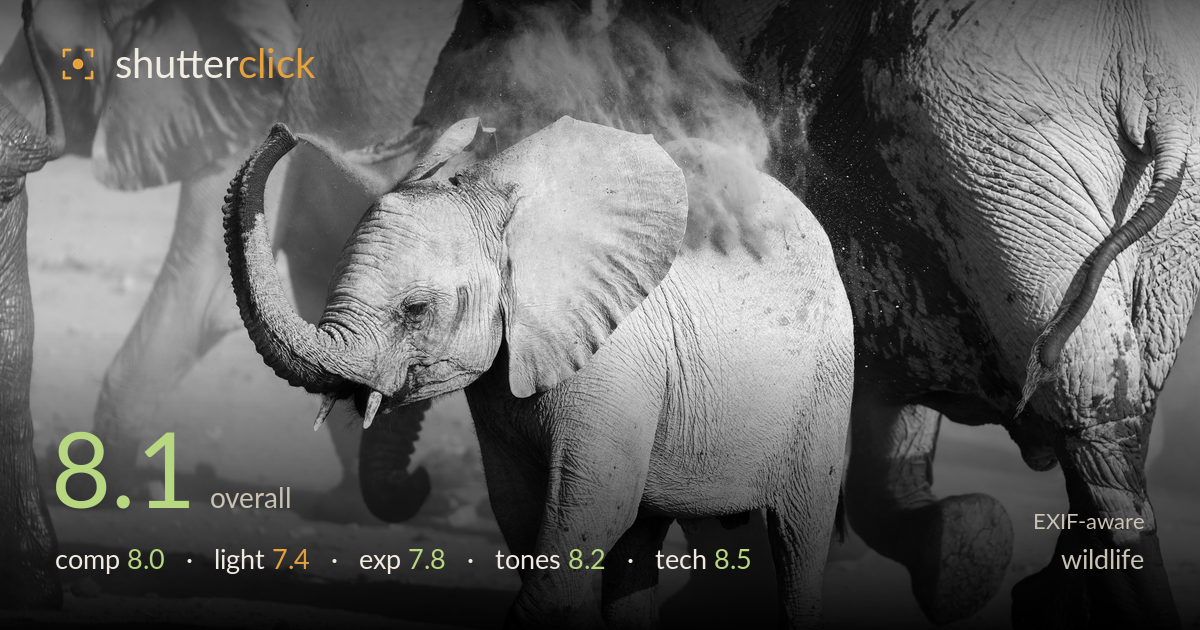
Young elephant in the dust
Photo by Giles Laurent

| Focal length | 164 mm |
| Aperture | f / 2.8 |
| Shutter | 1/5000 s |
| ISO | ISO 320 |
| Exp. comp. | 0.0 EV |
| Shot at | 14:09 · Jul 30, 2025 |
A charming juvenile elephant caught mid dust-bath with the trunk curled skyward makes this frame work — the gesture reads instantly and the monochrome treatment suits the dust and hide beautifully. The calf sits confidently in the frame with the larger animals cropped to context, and the dust plume gives dynamism. What holds it back is the harsh midday light flattening the modelling on the near side, and a slightly cluttered right edge where the adult's leg and tail compete. The head faces into open space, which helps, but the subject sits fractionally low. Strong wildlife moment executed cleanly.
The calf is placed left-of-centre facing into open ground on the right, which gives the raised trunk room to breathe and reads as a natural viewing direction. Cropping the surrounding adults to legs and flanks is a defensible choice that supplies scale and herd context without distraction. The dust plume rising behind the head adds energy and separates the subject from the darker adult. The main weakness is the busy right edge, where the adult's leg, tail and swinging foot crowd the frame and pull attention from the calf.
The light is high, hard midday sun, which is the honest reality of many waterhole and dust-bath scenes but not the most flattering. It flattens the modelling across the calf's flank and fills the frame with a bright, even wash that lacks directional shaping. Where it does work is the backlit dust — the plume glows and separates cleanly from the darker adult hide. Shadows under the belly and feet stay open enough to hold detail. Softer, lower side light would have carved more texture into the skin.
Exposure is well controlled for a bright, high-key scene. The pale, dusty hide and sand sit close to the highlights but retain detail, and the brightest dust and sunlit skin appear just short of clipping. Shadow areas under the belly and in the adult's dark hide hold their tonal separation without blocking up. The metering coped well with a scene that could easily have blown out. A touch more headroom on the brightest dust would guarantee no lost highlight texture, but the balance here is deliberate and holds together.
The black-and-white conversion is the strongest creative decision here. It unifies the dust, sand and grey hide into a coherent tonal field and lets the texture of wrinkled skin carry the image. Contrast is judged well — deep blacks in the adult's shadowed hide, clean bright dust, and a full range of mid-tones across the calf. The gradation on the ear and flank is smooth and convincing. A slightly deeper black point on the darkest adult would add punch, but the roll-off in the highlights is handled gracefully.
Excellent execution. The Sony A1 with the 70-200mm f/2.8 at 164mm is an ideal pairing for this reach and the 1/5000s shutter freezes the calf, the swinging adult foot and even the suspended dust particles crisply — no motion smear anywhere. ISO 320 keeps noise invisible and preserves clean tonal gradation in the smooth hide, which matters for a monochrome file. Focus lands accurately on the calf's eye and head, the critical plane for wildlife. The f/2.8 aperture gives pleasant separation from the darker adult behind, though at this distance depth of field is generous enough to keep the whole calf sharp. The only quibble is that f/2.8 wide open was not strictly necessary at 1/5000s in this much light — stopping to f/4 or f/5.6 would have bought margin on the depth of field with ISO to spare, though it makes little practical difference here. Overall a technically clean, decisive capture.
What would elevate it
Tags
Shot something like this?
Expert photo critique, on demand — scored across six categories, EXIF-aware. Start with 3 free critiques, no credit card.
critique my photo — free