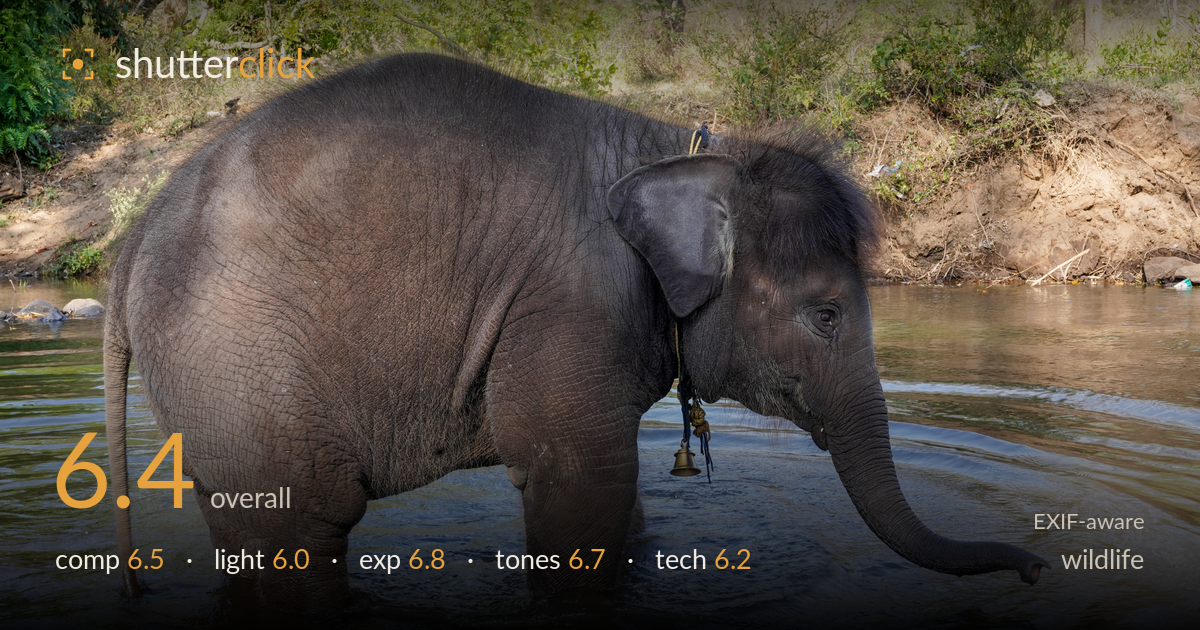
Young elephant wading in the river
Photo by This Photo was taken by Timothy A. Gonsalves. Feel free to use my photos, but pl

| Focal length | 55 mm |
| Aperture | f / 16.0 |
| Shutter | 1/60 s |
| ISO | ISO 500 |
| Exp. comp. | -0.3 EV |
| Shot at | 15:59 · Mar 9, 2021 |
A clean, full-body profile of a young Asian elephant with a pleasing arc of ripples radiating from its legs — a nice compositional gift from the water. The animal reads clearly against the earth bank, and the bell and neck rope tell a story of a working or captive elephant rather than a truly wild one. What holds the shot back most is the flat, high-sun light that leaves the dark hide muddy and lacking modelling, plus the extra headroom and tight tail crop that unbalance the frame. Sharpness is adequate but not crisp on the eye, the single element that most needs to sing.
The side-on profile fills the frame well and the concentric ripples around the legs add welcome dynamism and ground the subject in its setting. Placing the head in the right third works, and the eye and trunk have room to breathe. The tail is clipped awkwardly at the left edge, though, and there is a slug of dead headroom above the back. A slightly lower angle and a touch more space on the left would balance the mass. The busy bank competes a little for attention behind the head.
Overhead, near-midday sun is the main limitation. It flattens the elephant's dark, textured hide into a largely tonally uniform mass and robs the wrinkled skin of the raking modelling that would reveal its character. The catchlight-free eye sits in shadow under the brow, weakening the connection. The background foliage is blown in patches where sun breaks through. Softer, lower side light — early morning or late afternoon — would rake across the skin, separate the animal from the bank, and put life into the eye.
Exposure is handled sensibly for a difficult subject. The dark hide retains shadow detail without crushing, and the water highlights and specular ripples hold together with only minor clipping in the brightest sun-struck foliage. The -0.3 EV compensation was a reasonable call to protect those highlights. Midtones sit a touch low on the animal itself, contributing to the muddy read, so a modest local lift on the elephant in post would recover skin texture without sacrificing the well-controlled highlights elsewhere in the frame.
White balance is believable, with natural greens in the vegetation and a warm bank that reads true. The blue-grey water contrasts nicely against the earth tones. The elephant's grey, however, sits in a narrow, slightly flat tonal band that lacks the micro-contrast to make the wrinkled skin pop. Overall saturation is restrained and appropriate for the scene. A gentle contrast and clarity lift confined to the animal would open up the mid-tone gradation on the hide and give the subject the tonal separation the flat light denies it.
At 55mm on the FE 28-60, f/16 is far more depth of field than this single-plane profile needs, and it drags the shutter down to 1/60s — risky for a live animal that could flick an ear or trunk. Here the elephant is mostly still, so it holds, but the eye is not tack-sharp and the trunk tip shows slight softness. ISO 500 is clean and untroubled. The bigger issue is the diffraction penalty of f/16 on a full-frame sensor, which softens fine skin texture across the whole frame. f/8 would have preserved front-to-back sharpness on this flat subject while allowing roughly 1/250s to guarantee a crisp eye. Focus appears placed on the body mass rather than critically on the eye, the priority in any animal portrait. A single-point AF locked on the eye, a wider aperture, and a faster shutter would together lift the technical execution from adequate to genuinely sharp.
What would elevate it
Tags
Shot something like this?
Expert photo critique, on demand — scored across six categories, EXIF-aware. Start with 3 free critiques, no credit card.
critique my photo — free