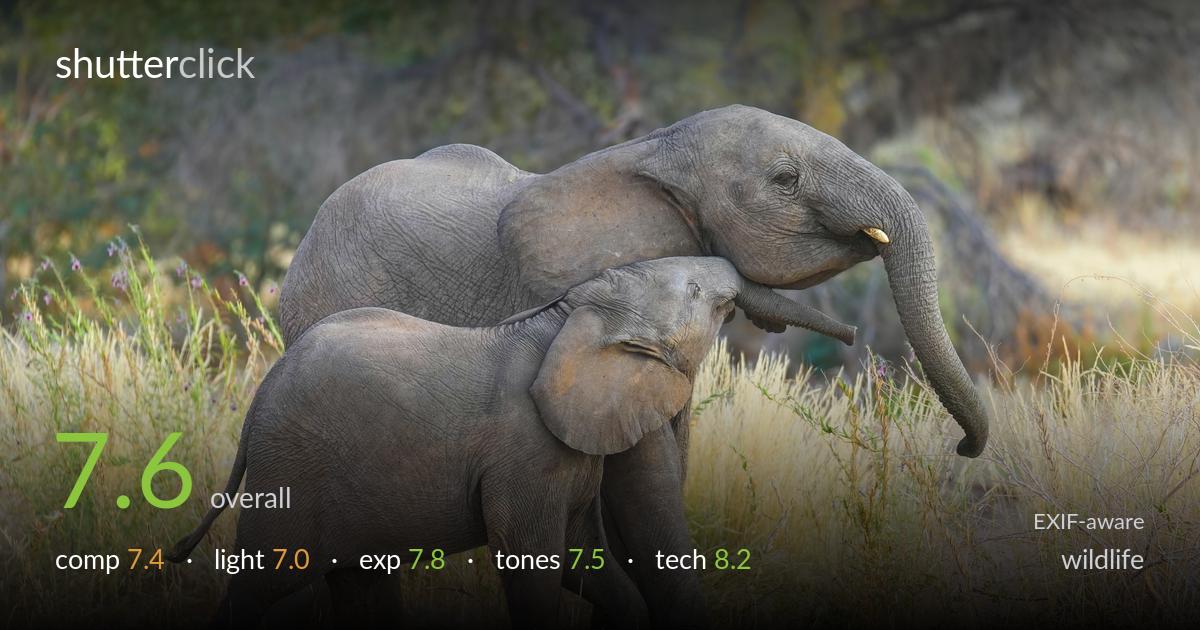
Young elephants embracing
Photo by Giles Laurent

| Focal length | 200 mm |
| Aperture | f / 2.8 |
| Shutter | 1/2000 s |
| ISO | ISO 320 |
| Exp. comp. | 0.0 EV |
| Shot at | 07:14 · Jul 28, 2025 |
An affectionate interaction between two young elephants, captured at a moment of genuine connection as one rests its trunk across the other's head. The behaviour is the picture's real strength and reads instantly. What holds it back is background separation: at 200mm and f/2.8 the bush behind is busy and only partially thrown out of focus, and the larger elephant's head merges tonally into the dense foliage. The light is flat and even rather than directional, which keeps the grey hides soft on texture. A cleaner backdrop and warmer raking light would lift a strong moment into a memorable one.
The overlapping pose creates an engaging tangle of forms, with the resting trunk forming a clear visual link between the two animals. Placing both subjects across the lower-centre frame keeps the action grounded in the grass. The trailing trunk reaching to the right adds direction and breathing room on that side. The larger elephant's head crowds the upper third against busy foliage, and the tip of the right-hand trunk sits close to the frame edge. A touch more room beyond that trunk would let the gesture resolve cleanly.
The light is soft and even, likely overcast or open shade, which keeps shadows gentle and avoids blown highlights on the pale grass. That softness is forgiving but flat: the elephants' wrinkled hide reads with little of the texture that a lower, raking side light would carve out. The closed eye of the nearer animal and the relaxed pose suit the quiet mood, but directional light from the side would add modelling to the bodies and lift them from the equally lit background.
Exposure is well judged. Highlight detail in the dry golden grass is retained without clipping, and the grey hides hold midtone separation across both animals. Shadow areas under the bellies and in the recessed skin folds keep detail rather than blocking up. The even light made this an easier metering task, and the zero exposure compensation was the right call here. The histogram looks comfortably contained with no significant loss at either end. A frame this balanced needs little correction beyond minor local lifting in the darker hide.
The warm golden grass against the cool grey hides gives a pleasant natural palette, and white balance looks accurate for the soft daylight. Contrast is modest, in keeping with the flat light, which leaves the overall tonal range a little gentle. The greens of the background bush feel slightly muted and could be separated more from the foreground tones. Saturation is restrained and believable rather than pushed. A subtle contrast lift on the elephants alone would help the subjects assert themselves against the similarly toned surroundings.
The Sony A1 with the 70-200mm GM at 200mm and 1/2000s comfortably freezes the gentle movement, with even the kicked-up dust by the rear leg rendered crisply. ISO 320 is clean with no visible noise penalty. Focus appears placed on the nearer elephant's eye and head region, which is sharp where the hide detail counts. The choice of f/2.8 is the debatable one: wide open at this focal length the depth of field is shallow, and while it softens the background it isn't enough to fully dissolve the busy bush, which still competes for attention. Stopping to f/4 or f/5.6 would have kept both elephants on the same crisp plane while still managing separation, since the background distance does most of the blurring work here. The lens choice is well suited to the working distance, and the autofocus tracking has clearly held the moment. Execution is high; the aperture decision is the one worth reconsidering.
What would elevate it
Tags
Shot something like this?
Expert photo critique, on demand — scored across six categories, EXIF-aware. Start with 3 free critiques, no credit card.
critique my photo — free