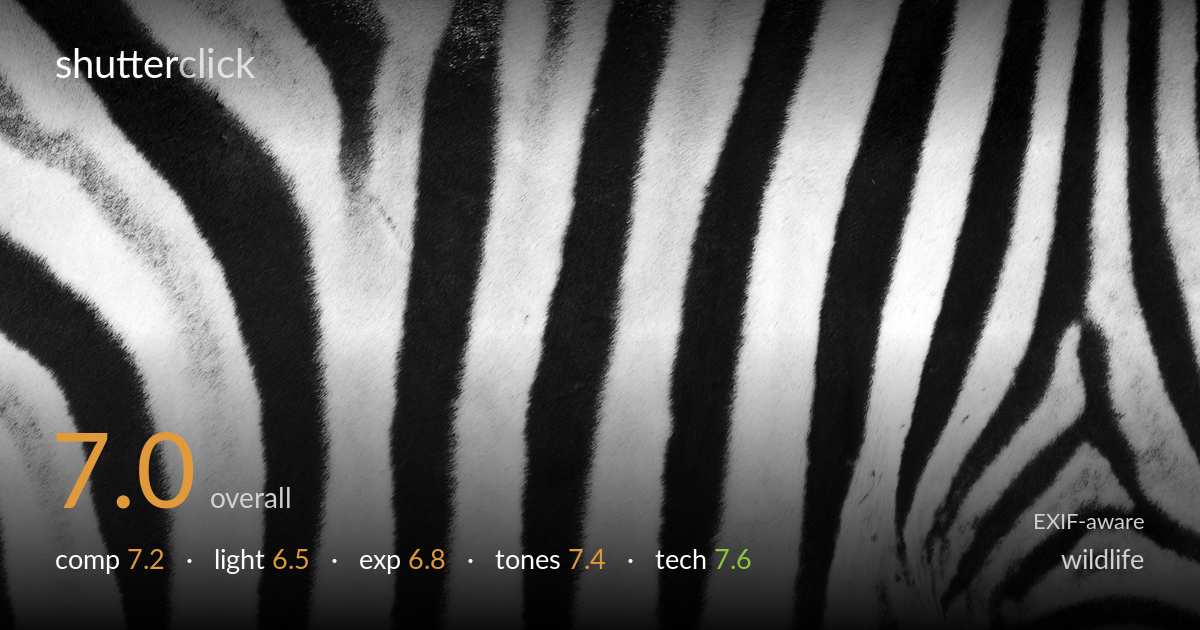
Zebra stripes as pattern
Photo by Giles Laurent

| Focal length | 800 mm |
| Aperture | f / 8.0 |
| Shutter | 1/2000 s |
| ISO | ISO 1250 |
| Exp. comp. | 0.0 EV |
| Shot at | 09:13 · Jul 30, 2025 |
This is an abstract reading of a wildlife subject — zebra hide filling the frame as pure pattern of black and white stripes. It works as graphic design: the flowing diagonal lines on the left, the convergence point at lower right where stripes radiate, and the rhythmic verticals through the centre all create genuine visual interest. What holds it back from the wildlife brief is the absence of any animal cue — no eye, no behaviour, no context. Judged as abstract pattern it's strong; judged as wildlife it sidesteps the genre's core demands. The texture rendering and tonal separation are its real assets.
The frame is filled edge to edge with pattern, which is the right instinct for this kind of abstract treatment. The lower-right convergence — where stripes meet and radiate — is the strongest compositional anchor and could have been weighted more deliberately. The flowing diagonals on the left side give the frame movement and break the monotony of the central verticals. As it stands the eye wanders without a clear resting point; positioning that radiating junction nearer a third would give the rhythm a destination rather than letting it drift across uniformly.
The light is soft and fairly flat, which keeps the stripes clean but flattens the hide's three-dimensionality. A few specular highlights across the upper black stripes hint at directional light catching the coat, and those add welcome life. A lower, more raking light would carve the fur's texture and the subtle ridges of the body, turning a flat pattern into something with form. As rendered the lighting serves the graphic intent adequately but does little to sculpt the surface or suggest the animal beneath.
Exposure is well controlled for a high-contrast subject. The whites hold texture rather than blowing out, and the blacks retain some detail in the fur rather than crushing to void — a difficult balance with this much tonal extremity. A few upper-left whites approach clipping but stay just inside. The midtone placement keeps the grey transitions between stripes readable. Overall a confident, deliberate exposure that respects the dynamic range of the scene without sacrificing the deep blacks the pattern needs.
The black-and-white rendering is the photograph's strongest element. Shadow depth is rich without going inky, highlight roll-off is gentle on the whites, and the mid-tone gradation in the fur shows real texture — individual hairs and subtle tonal shifts within each stripe. Contrast is judged well for the subject, separating the bands cleanly while preserving detail. The grey shadowing where stripes blur into one another adds dimension. This is a tonal treatment that does justice to the material.
The 800mm at f/8 and 1/2000s is a sound set of choices for a moving wildlife subject, and the shutter has frozen everything cleanly — no motion blur compromises the fur detail. ISO 1250 is reasonable given the aperture and reach, and noise is well controlled, kept invisible by the bright tones. Focus sits accurately on the hide, with sharpness carrying the fine fur texture across the frame, though at this magnification the plane of focus only holds where the body is square to the sensor. The long lens has compressed the surface into a flat pattern, which suits the abstract intent but eliminates any subject context. The execution is technically clean — settings appropriate, focus accurate, noise managed. The one missed opportunity is that this much glass and a sharp eye on the animal would have served the wildlife genre more directly; the gear was capable of a stronger species portrait than a texture study.
What would elevate it
Tags
Shot something like this?
Expert photo critique, on demand — scored across six categories, EXIF-aware. Start with 3 free critiques, no credit card.
critique my photo — free