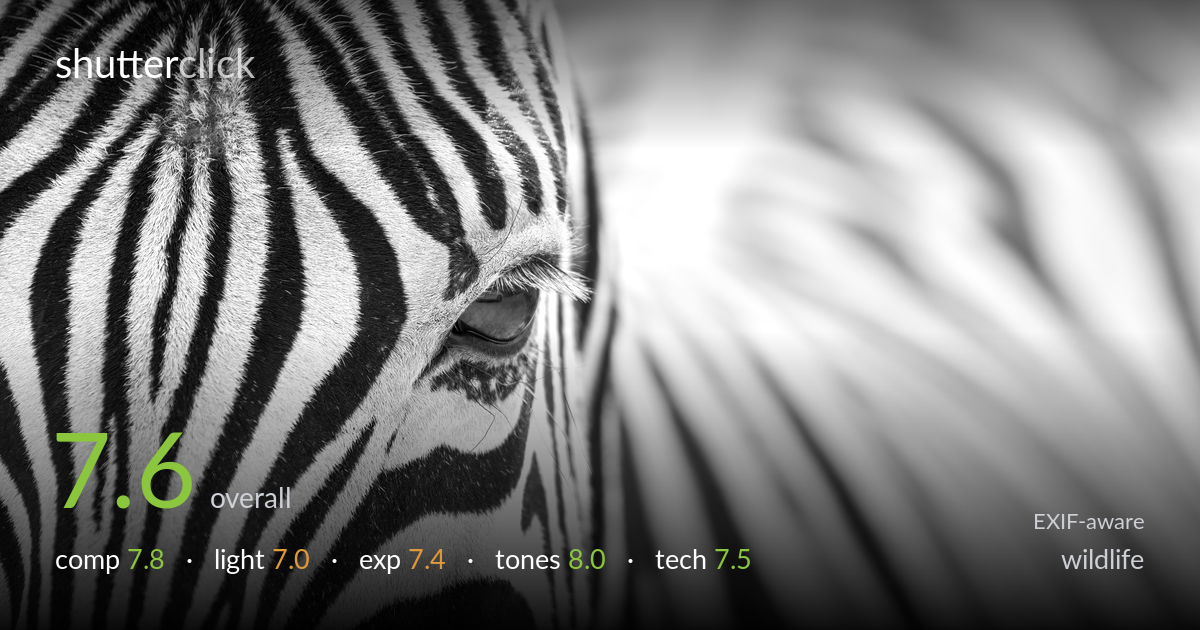
Zebra stripes in black and white
Photo by Giles Laurent

| Focal length | 200 mm |
| Aperture | f / 2.8 |
| Shutter | 1/6400 s |
| ISO | ISO 320 |
| Exp. comp. | 0.0 EV |
| Shot at | 12:47 · Jul 30, 2025 |
A bold, graphic interpretation of a zebra that leans into the stripe pattern as its true subject — the sharp left half is rich with detail while the out-of-focus right half dissolves the pattern into soft tonal waves. The black-and-white treatment is the right call, amplifying the natural geometry. What holds it back is the eye: it sits in shadow and reads softer than the surrounding fur, robbing the frame of the anchor that makes a wildlife portrait land. The shallow depth of field is a deliberate creative gamble that mostly pays off, though it sacrifices the connection a tack-sharp eye would deliver.
The split between detailed stripes on the left and the dissolving soft pattern on the right is the strongest idea here — it turns the zebra into a study of pattern rather than a literal portrait. The eye sits roughly on a thirds intersection, giving it weight. The diagonal flow of the stripes leads the eye effectively across the frame. The right side risks reading as empty rather than intentional, but the gradual blur keeps it tied to the subject rather than dead space.
Soft, diffused light renders the fur cleanly and keeps the white stripes from blowing out, which suits a high-key monochrome treatment. The flatness, however, costs the image dimensionality — there is little directional modeling to give the muzzle and brow form, and the eye recedes into shadow rather than catching a highlight. A touch of directional light or a catchlight would have brought the eye forward and added the spark a wildlife close-up needs to feel alive.
Exposure is well managed for a high-key subject. The white stripes hold detail without clipping, and the blacks stay deep without crushing into featureless voids, preserving the fur texture. The eye sits a little dark and could use a localized lift to recover the iris detail. Overall the histogram appears to span the range cleanly, and the bright soft background is handled without burning out — a deliberate, controlled exposure that serves the graphic intent.
The monochrome conversion is the highlight here. Contrast is judged well — crisp blacks against clean whites give the stripes their punch, while the mid-tones in the fur retain subtle gradation. The soft right side rolls off into smooth greys that contrast nicely with the hard-edged stripes on the left. Highlight roll-off in the bright background is gentle and natural. The tonal separation between the sharp and blurred halves is what gives the frame its rhythm and visual interest.
The Sony A1 paired with the 70-200mm f/2.8 GM at 200mm and f/2.8 is a capable kit, and the settings are largely sound. The 1/6400s shutter at ISO 320 is fast enough to freeze any movement and keeps noise negligible — both correct calls. The creative gamble is f/2.8: at this magnification it yields a razor-thin plane of focus, which is why only the left stripes are tack-sharp while the eye sits slightly behind the sharpest plane and the right side melts away. For a pattern study this works, but for a wildlife portrait the eye should be the sharpest point in the frame, and here it isn't quite. Stopping down to f/5.6 or f/8 would have pulled the eye and more of the face into critical focus while still softening the background at this focal length. Focus appears placed on the forehead stripes rather than the eye — a small but consequential miss for the genre.
What would elevate it
Tags
Shot something like this?
Expert photo critique, on demand — scored across six categories, EXIF-aware. Start with 3 free critiques, no credit card.
critique my photo — free