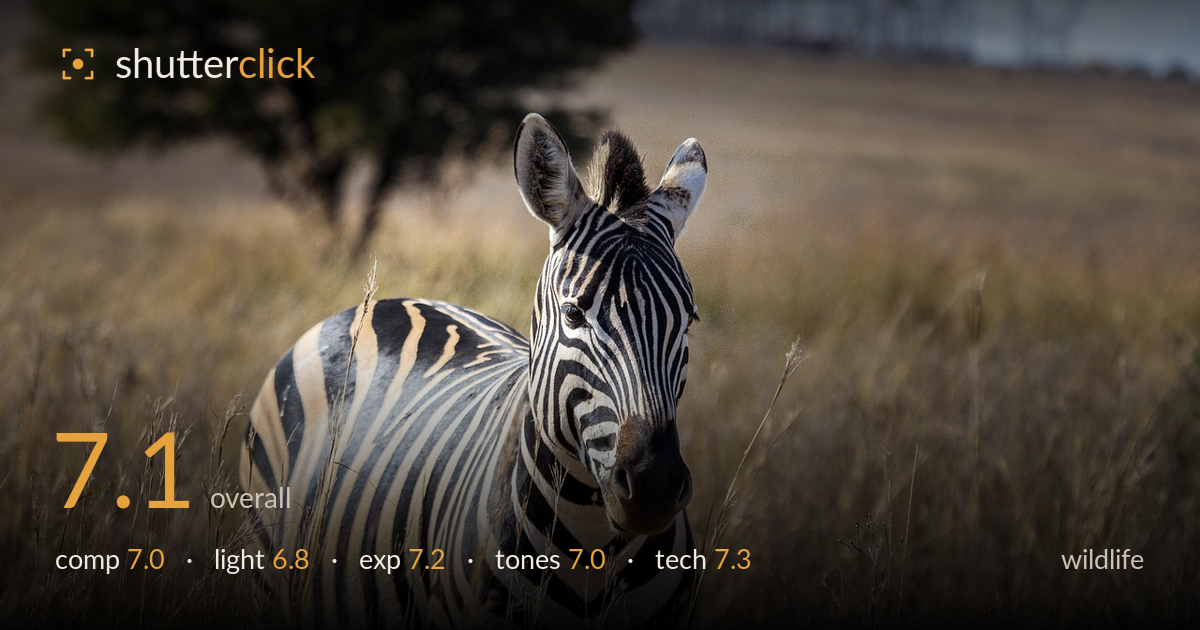
Zebra watching from the tall grass
Photo by auretjansen

No EXIF metadata in this file
Technical analysis based on visual assessment only.
A direct, engaging encounter with a zebra facing the camera, its striped pattern reading crisply against soft golden grass. The eye holds attention and the animal fills a strong portion of the frame. Two things hold it back: foreground grass drifts across the lower body and muzzle, softening the read of the subject, and a line of power pylons intrudes on the upper-right horizon, breaking the wilderness illusion. The light is flat and even rather than shaped. A cleaner shooting angle above the grass and a tighter framing away from the man-made structures would lift this from a solid record to a strong wildlife portrait.
The zebra sits slightly right of centre with its body angled into the frame, a natural and workable placement. The out-of-focus tree on the left adds context without competing. However, the foreground grass crosses the chest and muzzle, breaking the clean line of the subject, and the power pylons on the upper-right skyline pull the eye away and undercut the sense of wild habitat. A framing that either excluded those structures or lowered the horizon to keep sky minimal would strengthen the composition considerably.
The light is soft and fairly even, which keeps detail in both the black stripes and the white without harsh clipping, but it lacks direction and modelling. The scene reads a little flat, with no clear rim or side light to separate the animal from the grass or add dimension to the face. Early or late golden-hour light raking across the plain would carve out the muzzle and neck and warm the whole scene, giving the dry grass more glow and the subject more presence.
Exposure is well controlled for a high-contrast subject. The white stripes retain texture without blowing out and the black stripes hold shape without blocking into pure shadow, which is the harder balance to strike on a zebra. Midtones in the grass sit at a comfortable brightness. The distant field and sky in the upper right run slightly bright and washed, but that is a minor concern given the correct priority on the animal itself. Overall the exposure decisions read as deliberate and successful.
The palette is a muted, earthy blend of tan grass, cool grey background and the crisp monochrome of the zebra, which works pleasantly and keeps focus on the subject. White balance is neutral and believable. Contrast is moderate and suits the flat light. The overall look is a touch subdued; a small lift in contrast and warmth would give the dry grass more richness and the stripes more snap. As it stands the tones are honest and coherent without being especially striking.
Focus lands convincingly on the head and eye, which is the priority for a wildlife portrait, and the stripe detail across the face and neck is sharp and well resolved. The shallow depth of field renders the tree and distant field into a smooth blur that isolates the subject nicely, suggesting a longer focal length used well. The main technical compromise is the intervening grass: several stems fall between lens and subject, catching focus and drawing soft veils across the muzzle and chest that slightly degrade the clean read of the animal. Shifting position to shoot over or through a gap in the grass, or a marginally higher vantage point, would clear that obstruction. Noise is well controlled and there is no visible motion blur, so shutter speed handled the static subject easily. The background separation and eye sharpness are the strongest technical elements; the foreground clutter is the fixable weakness.
What would elevate it
Tags
Shot something like this?
Expert photo critique, on demand — scored across six categories, EXIF-aware. Start with 3 free critiques, no credit card.
critique my photo — free